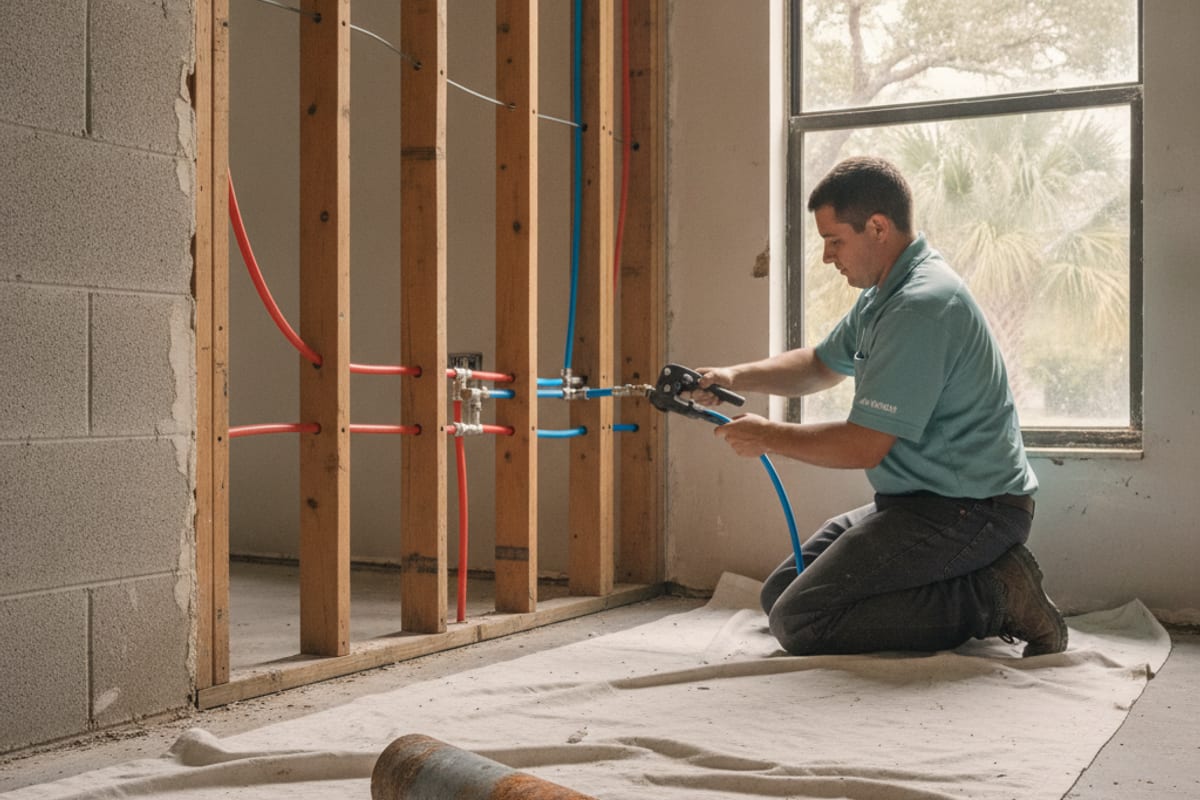
The galvanized pipe replacement cost for a whole Tampa Bay house runs $3,500 to $15,000 in 2026. This is a whole-house job, not a single leaking section. Home size, fixture count, access, and pipe material move the final quote. A section repair runs $300 to $1,200 when the remaining plumbing is still serviceable.
What is the galvanized pipe replacement cost in Tampa Bay?
A whole-home galvanized repipe costs $3,500 to $15,000 across Tampa Bay. The low end fits a modest single-family rental with open access. Historic homes, larger layouts, and difficult wall access move toward the high end.
The age and construction of Tampa Bay homes create wide differences. A compact Sulphur Springs rental isn’t the same job as a historic Hyde Park house. Beach cottages also bring tighter lots and different access conditions.
Here is how the local range changes by home type:
| Tampa Bay home type | Whole-home replacement cost | What changes the job |
|---|---|---|
| Modest Sulphur Springs rental | $3,500 to $7,000 | A smaller layout can reduce pipe runs and fixture connections. |
| Seminole Heights or Tampa Heights bungalow | $4,000 to $8,500 | Older walls and previous alterations can limit access. |
| Pass-a-Grille or St. Pete Beach cottage | $4,500 to $9,000 | Tight lots and compact working areas affect routing. |
| Ballast Point or Ozona ranch | $5,000 to $12,000 | Longer horizontal runs serve spread-out fixtures. |
| Temple Terrace or historic-district home | $4,500 to $13,000 | Finished surfaces and older construction complicate access. |
| Historic Hyde Park home | $6,000 to $14,000 | Larger layouts and protected finishes add labor. |
| Older South Tampa, Westshore, or MacDill-area home | $4,000 to $15,000 | Size, access, and pipe material create the widest range. |
These figures cover different home types, not interchangeable bids. A plumber still needs to trace the supply system and count fixtures. Our repipe service connects homeowners with licensed plumbers who can inspect the layout and price the actual work.
What makes a galvanized repipe cost more?
Access usually creates the biggest difference between two similar homes. Pipes behind tile, cabinets, finished ceilings, or tight crawl areas take longer to reach. A clear route through an attic or open utility area reduces that work.
Square footage matters because longer routes require more pipe and labor. Fixture count matters too. Each sink, toilet, shower, hose connection, and appliance supply needs a new connection.
Galvanized steel also takes more labor to remove than polybutylene. Threaded, corroded sections can resist disassembly and create extra work inside confined spaces. That difference helps push older galvanized houses toward the higher end.
Material choice changes the quote as well. PEX and copper carry different material and installation costs. The plumbers we send can explain which routes work inside your particular walls.
Tampa Bay’s housing patterns make location useful context. Galvanized lines still appear in older central Tampa neighborhoods and parts of Pinellas County. Pinellas Park homes built from 1950 through 1985 commonly still have them.
Hard water accelerates internal corrosion in galvanized pipe. A water softener service can address mineral buildup in the home’s water, but it can’t restore pipe walls already thinned by corrosion.
Should you repair one section or repipe the house?
A section repair makes sense when the damage is isolated and the remaining supply system is serviceable. That repair runs $300 to $1,200. It can stop one accessible leak without opening unrelated areas.
Galvanized pipe often fails in clusters once corrosion becomes established. Patching one leak can be followed by another failure a few months later. Repeated repairs become harder to justify when pressure is falling throughout the house.
| Situation | Section repair | Whole-home repipe |
|---|---|---|
| One isolated, accessible failure | Limits work to the damaged area. | May replace more pipe than the current problem requires. |
| Several recent leaks | Leaves other aging sections in service. | Removes the shared source of recurring supply-line failures. |
| Low pressure across several fixtures | Won’t reopen narrowed pipe elsewhere. | Replaces interior passages restricted by corrosion. |
| Mixed old and new supply piping | Can preserve serviceable newer sections. | Creates one planned supply layout when old pipe is widespread. |
| Finished walls with difficult access | Opens a smaller work area now. | Requires more access but avoids repeating it for later failures. |
Galvanized corrosion grows inside the pipe. The buildup narrows its interior until water pressure drops. Fixtures farthest from the incoming supply, including second-floor bathrooms, often show the loss most clearly.
A diagnostic visit helps separate a local leak from a failing system. Camera inspection plus pressure testing to confirm the scope runs $250 to $500. Leak detection runs $250 to $450 when applied toward the repair.
Does Florida’s new permit exemption cover a repipe?
Florida’s new permit exemption does not cover plumbing work. CS/CS/HB 803 took effect July 1, 2026, and created an exemption for certain work valued below $7,500. Its carve-outs expressly include “Any electrical, plumbing, structural, mechanical, or gas work performed on property containing a single-family dwelling.”
That means a repipe doesn’t become permit-exempt because its quote falls below $7,500. The act also states, “A construction project may not be divided into more than one project for the purpose of evading the requirements of this paragraph.”
The flood-hazard carve-out is separate from the plumbing carve-out. Where the exemption does apply to another kind of work, the owner must request it in writing and provide a contract or other supporting documentation. The enrolled Florida legislation explains the exemption and its limits.
The same act creates a five-business-day decision clock for a narrower permit group. It covers a plumbing permit for an existing single-family dwelling valued below $15,000 when the applicant uses a local government plans reviewer. The government must approve, approve with conditions, or deny a complete and sufficient application within that period. This isn’t a five-day promise for every permit or project.
What does a plumbing permit cost locally?
The City of Tampa lists its residential Plumbing (general) permit at $120. Its trade permit fee schedule also adds the Florida Building Permit Surcharge, calculated as 2.5% of permit value or a $4 minimum. That surcharge isn’t included in the listed permit fee.
Unincorporated Hillsborough County lists residential Plumbing (General) at $130. The county describes trade permits as single-trade projects requiring inspections without plan review. Its schedule also says the full fee is due when submitted. Hillsborough County provides its current building permit fee information.
Those charges are permit lines, not the cost of replacing the pipes. Square footage, fixture count, access, and material account for far more of the job.
No single fee applies across Pinellas County and its individual cities. Confirm the current charge with the permitting office serving the property before setting the budget.
Does replacing galvanized pipes with PEX cost less?
PEX generally costs less than copper for the same typical house. For a three-bedroom, two-bath single-story Tampa Bay home, a PEX repipe runs roughly $4,000 to $8,000. Copper runs $8,000 to $15,000 or more for that same home type.
Those are material figures for one common house size, not a quote for yours. The home’s access and layout still control the final scope. Our detailed PEX versus copper repipe guide covers that choice without confusing it with galvanized removal.
Galvanized plumbing also belongs to a different housing era than polybutylene. Galvanized commonly appears in older homes, while polybutylene is associated with later construction. The polybutylene repiping guide explains that separate problem.
How can you tell if your pipes are galvanized?
The magnet-and-coin test can help identify exposed galvanized supply pipe. A plumber should still trace the entire system before quoting replacement. Older houses often contain changes from several rounds of repair.
Rusty water and weak pressure can point toward internal corrosion, but each symptom has other possible causes. Our guides explain what brown tap water and low water pressure can reveal before walls are opened.
Galvanized supply lines are well beyond their expected 40-to-50-year lifespan in many older Tampa Bay homes. Corrosion starts inside, so the outside can look serviceable while the passage has narrowed. The pipe identification guide shows how the magnet-and-coin check fits into a closer inspection.
Home age helps narrow the possibilities before anyone opens a wall. The bungalows a Seminole Heights plumber works in were built well inside the galvanized era. In Pinellas Park, mid-century homes deserve the same closer look at their original supply piping.
Frequently asked questions
How much does it cost to replace all galvanized pipes?
Replacing all galvanized supply pipes costs $3,500 to $15,000 in Tampa Bay. A modest rental may stay near the low end. Historic homes, larger layouts, copper, and difficult access push the work higher.
Can a plumber replace only one galvanized section?
A plumber can replace an isolated galvanized section when the surrounding system remains serviceable. Section repairs run $300 to $1,200. Widespread pressure loss or several recent leaks usually makes a whole-home comparison more useful.
Is a plumbing permit required below $7,500?
Florida’s 2026 exemption for certain work below $7,500 expressly excludes plumbing on single-family properties. A lower repipe quote doesn’t activate that exemption. The permitting jurisdiction determines the application path for the property.
How long should galvanized plumbing last?
Galvanized supply lines have an expected lifespan of 40 to 50 years. Many surviving systems around Tampa Bay are already beyond that range. Their actual condition depends on internal corrosion, access, and previous repairs.
Does hard water damage galvanized pipe?
Tampa’s hard water accelerates corrosion inside galvanized supply pipe. Mineral buildup and corrosion narrow the passage, reducing pressure at distant fixtures. Water treatment can’t rebuild pipe that has already deteriorated.
Is brown water proof that the house needs repiping?
Brown water alone doesn’t prove that a whole-home repipe is necessary. Utility flushing, disturbed sediment, a corroding water heater, and galvanized supply lines can create similar symptoms. Check whether the discoloration affects hot water, cold water, or both before choosing a repair path.
When to call us
Call when galvanized leaks are repeating, pressure is falling, or you need a whole-home quote. Tampa Plumbing Pro answers 24/7 and covers Hillsborough, Pinellas, and Pasco counties. Call us at (813) 590-0625.