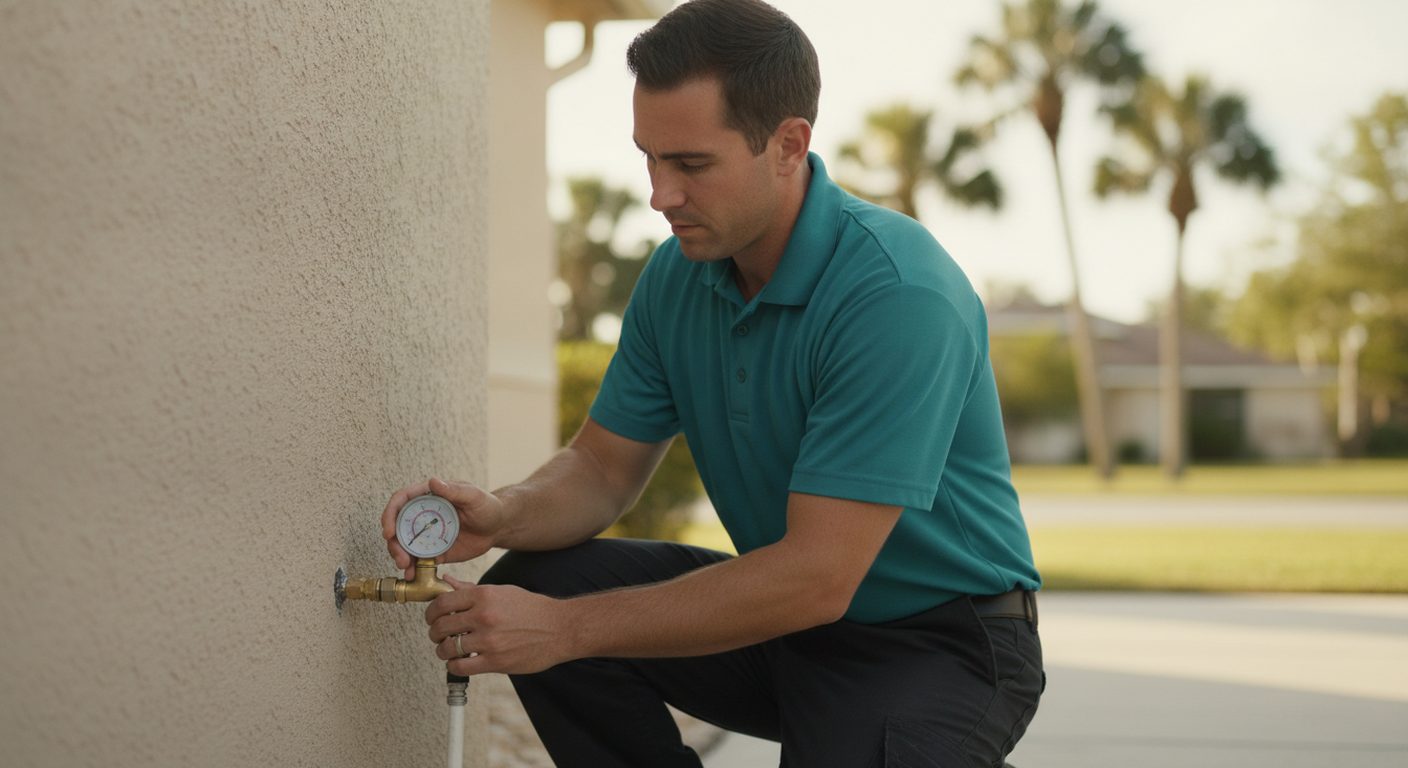
Low water pressure in a Tampa Bay home usually comes down to one of five things: mineral scale narrowing old pipe, a failed pressure-reducing valve, a slab leak pulling pressure to one spot, a well pump or pressure tank problem, or a city-side issue that isn’t yours to fix at all. Which one it is depends on whether the drop hits the whole house or just one fixture, and whether you’re on city water or a well.
Before anyone touches a wrench, there’s a free five-minute test that rules out half the list.
Start outside: is it your house or the city’s line?
The City of Tampa’s own guidance for pressure complaints starts at the hose spigot, not inside the house. If pressure at an outside spigot is strong and normal, the problem lives in your plumbing, not the water main. If the outside spigot is weak too, the issue may be upstream of your meter, and that’s a call to your utility, not a plumber.
This matters because it’s the fastest way to stop guessing. A plumber can fix a corroded pipe, a bad valve, or a failing pump. Nobody but the utility can fix pressure that’s low before it ever reaches your property line.
There’s a middle case worth ruling out too. If pressure dropped and the ground between the meter and the house is soggy, the buried service line may be leaking rather than restricted. That line is the homeowner’s responsibility here, and water line repair in Tampa Bay has its own rules about what your utility will credit back.
Mineral scale narrowing your pipes
If the spigot test says the problem is yours, age of the house is the next question. Homes built before the 1970s across Tampa and St. Petersburg, and the older parts of the county, still run galvanized or cast-iron supply lines, and Tampa Bay’s hard water leaves mineral scale on the inside of that pipe year after year. The effective diameter shrinks the same way a clogged artery does, and pressure drops across the whole house, worst at the farthest fixture from the meter. When that same corrosion starts shedding rust into the flow, you get brown tap water along with the weak pressure.
This is gradual, not sudden. If your pressure has been sliding for a year or more rather than dropping overnight, scale is the likely cause, and a whole-home water softener slows the buildup going forward even though it won’t reverse decades of scale already inside old pipe. Severely scaled galvanized line usually means a repipe, not a softener, is the real fix.
A pressure-reducing valve that’s failed
Florida’s plumbing code requires a pressure-reducing valve on any home where static pressure exceeds 80 psi, and most newer Tampa Bay construction on city water has one installed near the main shutoff. When that valve fails, it usually fails in one of two directions. A valve stuck closed chokes flow to a trickle throughout the house. A valve stuck open lets full street pressure straight into your pipes, which shows up as banging pipes, a suddenly noisy water heater, or a spike in pressure rather than a drop. That second failure is its own problem with its own fixes, and our guide to high water pressure in a Tampa Bay house walks through testing for it and what the code requires above 80 psi.
A PRV is a serial part with a rated lifespan, typically 8 to 15 years, and homeowners rarely know theirs exists until it fails. If your home has one and nobody’s touched it since it was installed, and pressure has dropped house-wide with no obvious age-related cause, testing the valve is a five-minute job that rules out a real culprit before anyone assumes the pipes themselves are the problem.
Only one fixture is weak? Check the aerator first
Everything above explains whole-house pressure loss. If it’s a single shower or one specific faucet running noticeably weaker than the rest of the house, unscrew the aerator or showerhead and look for scale. Hard water clogs those screens first, and a rinse often restores flow without opening a wall.
If the aerator is clean and that one fixture is still weak, that’s a different and more urgent signal: it can be an early warning of a slab leak, where water is diverting into the slab or the yard instead of reaching that fixture at full pressure. A slab leak that’s caught early is a repair, not a repipe, so don’t wait on a single-fixture drop the way you might wait on a house-wide one.
On well water, the pump or tank is the usual cause
Homes on private wells across Pasco and rural Hillsborough follow a different pattern entirely. Whole-house pressure that’s weak or surges rather than staying steady points to the pressure tank or pressure switch, not city infrastructure that doesn’t exist out there. A waterlogged tank or a pitted switch contact causes exactly this symptom, and it’s a cheaper fix than most homeowners assume, well before a pump replacement is on the table.
What the code says pressure should actually be
Florida’s plumbing code doesn’t just cap pressure at 80 psi. It also sets minimums at the fixture: a lavatory needs at least 8 psi to function, a toilet with a flushometer valve needs 35 to 45 psi to flush correctly, and a urinal needs at least 25 psi. Most Tampa Bay utilities deliver 45 to 60 psi at the meter under normal flow, comfortably above every one of those minimums. If a fixture in your home won’t perform even close to that range, the shortfall is happening somewhere between your meter and that fixture, which is exactly why the diagnosis has to start at the spigot and work inward instead of guessing at the far end first.
Frequently asked questions
Why is my water pressure low in only one part of the house?
A localized drop, one shower or one sink noticeably weaker than the rest of the house, is a different problem than whole-house pressure loss. Check the aerator or showerhead for scale first. If that screen is clean and the fixture is still weak, it can be an early sign of a slab leak, where water is escaping into the foundation before it reaches that fixture. Whole-house pressure loss is more often scale, a failed pressure valve, or a well pump issue.
Will a water softener fix my low water pressure?
Only if the cause is active mineral buildup happening now, and only going forward. A softener stops new scale from forming, but it doesn’t dissolve or remove decades of scale already inside old galvanized or cast-iron pipe. If your home’s pipes are severely scaled, a repipe restores pressure; a softener just slows the next round of damage.
How do I know if my pressure-reducing valve failed?
Sudden pressure loss across the whole house, or the opposite, banging pipes and a suddenly loud water heater, both point to a PRV problem rather than gradual scale buildup. Testing the valve takes a few minutes with a pressure gauge at an outside spigot, and it’s worth ruling out before assuming the pipes themselves are the cause.
Is low water pressure ever the city’s fault, not mine?
Yes. If pressure is weak at an outside spigot as well as inside the house, the issue may be upstream of your meter, and that’s the utility’s responsibility to investigate, not a plumbing repair. Checking the outside spigot first is the fastest way to know which side of the meter the problem is on.
What’s normal water pressure for a Tampa Bay home?
Most Tampa Bay utilities deliver somewhere around 45 to 60 psi at the meter under normal use, with Florida’s plumbing code requiring a pressure-reducing valve on anything above 80 psi. Fixtures are rated to work reliably within that range, so a fixture that struggles even at normal house pressure usually has its own local problem.
My well pump seems fine but pressure still surges. What else could it be?
A pressure tank that’s lost its air charge causes exactly this pattern: pressure that swings instead of holding steady, even when the pump itself tests fine electrically. That’s a tank or switch repair, not a pump replacement, and it’s worth ruling out first since it’s the far cheaper fix.
Get a real diagnosis instead of a guess
The pros we send test pressure at the meter, at an outside spigot, and at the affected fixture, so they know which side of your plumbing the problem is on before anyone recommends anything. Whether it turns out to be scale, a failed valve, a slab leak, or a well pump issue, you’ll know the actual cause and the actual cost before any work starts.
Call Tampa Plumbing Pro at (813) 590-0625 and we’ll match you with a licensed plumber to find out why your pressure dropped.