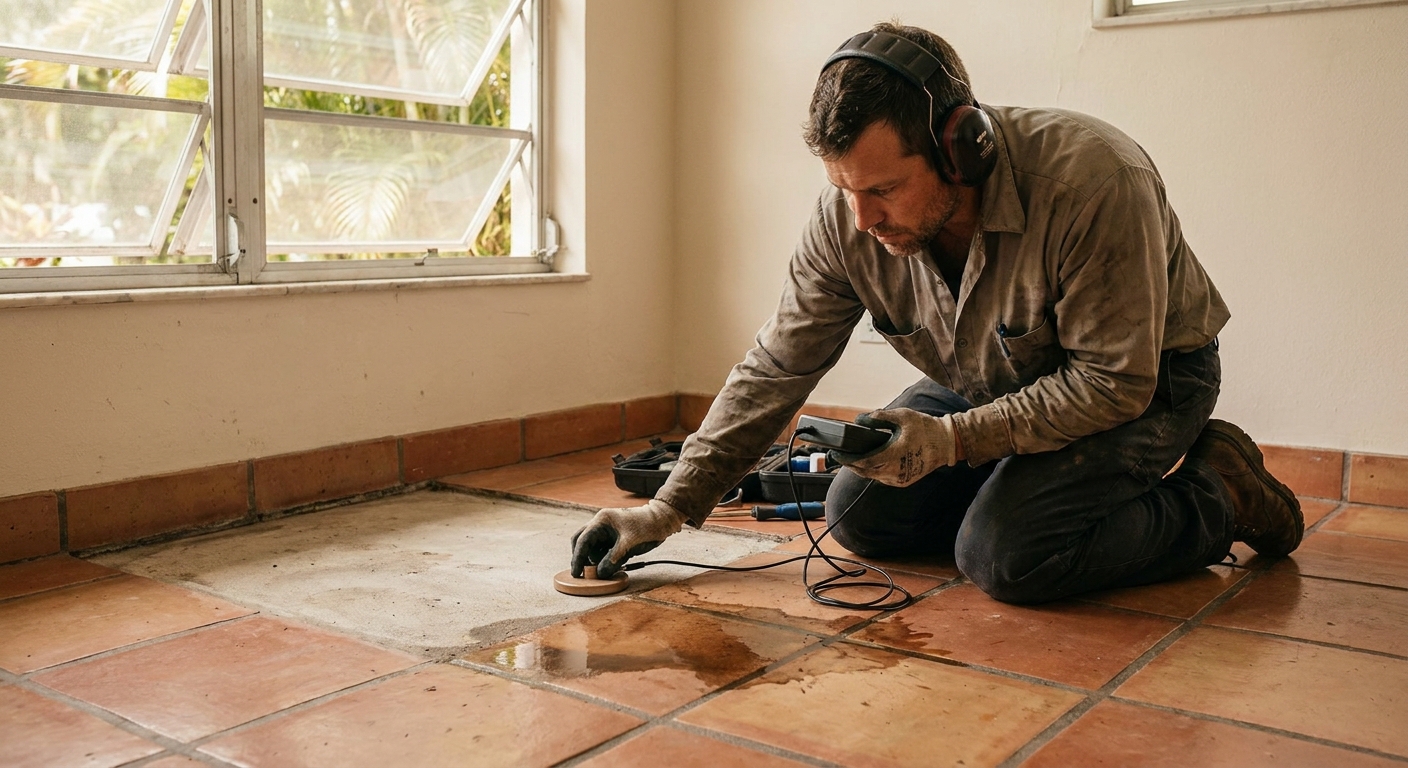
Slab-on-grade construction is the default in Tampa Bay, and it comes with a plumbing problem most homeowners never think about until water starts showing up somewhere it shouldn’t. New single-family homes here are typically built on a slab, with the water and drain lines running directly underneath or through the concrete itself. When those lines fail, you don’t get a puddle under a sink. You get a slab leak.
Why Florida slabs are especially prone to this
A slab leak happens when a water line running under or through the concrete foundation develops a leak. In most of the country this is a rare event. In Tampa Bay, slab-on-grade housing plus sandy soil makes it a regular failure, not a rarity.
Three local factors stack up against slab homes. First, sandy, shifting soil across Hillsborough and Pinellas counties settles and moves more than clay-based soil, and that ground movement stresses pipes running through the slab over years. Second, Tampa’s hard water, especially in areas hitting 15-17+ grains per gallon in dry season, accelerates internal pipe corrosion the same way it damages water heaters. Third, a huge share of the metro’s housing stock was built during the polybutylene era (1978-1995), and poly-b under a slab is even harder to catch early than poly-b in a wall, because you can’t see it degrading.
The signs that actually mean something
A slab leak rarely announces itself with an obvious puddle. It shows up as a cluster of smaller, easy-to-dismiss signs.
An unexplained jump in your water bill. If your bill climbs with no change in household water use, that’s an early indicator worth checking. A slab leak can run continuously, day and night, even when nobody’s home.
A warm spot on the floor. If a hot water line is the one leaking, tile or flooring directly above it can feel noticeably warmer than the surrounding floor. A cold-line leak will not give you that warm patch. It shows up as a climbing bill, a spinning meter, or dampness without heat. That hot-versus-cold split is one of the first things a detection visit sorts out.
The sound of running water with everything off. Turn off every fixture and appliance in the house, then check your water meter. If the leak indicator dial is still spinning, water is moving somewhere it shouldn’t be.
Cracks in flooring or walls, or doors that stop closing right. As water erodes the soil under a slab or pools beneath it, the slab itself can shift slightly, enough to crack tile grout lines, crack drywall near the floor, or make a door start sticking.
Damp carpet or baseboards with no obvious source. If water is wicking up through a slab from below, carpet near an interior wall can feel damp or musty without any visible leak nearby.
Low water pressure at one or two fixtures specifically. A slab leak diverting water pressure can show up as one shower or one faucet running noticeably weaker than the rest of the house. That’s a different pattern than whole-house low pressure, which usually traces to scale, a failed pressure valve, or your well pump instead.
Any one of these alone might be nothing. Two or more together, especially paired with a rising water bill, is worth a professional look before it gets worse.
One thing to rule out first, because the bill looks identical either way. If the wet ground is outside, between the meter box and the house, you’re probably looking at the buried supply line rather than the slab. That’s a different repair with a different rulebook, and who pays for a water line repair here is worth knowing before anyone starts digging.
What happens if you ignore it
An active slab leak doesn’t stay small. Left alone, it saturates the soil under the foundation, which can lead to real structural settling over months. It also creates ideal conditions for mold growth under flooring, which is a bigger and more expensive problem than the plumbing fix itself. And the water bill keeps climbing the entire time, which is often the first thing a homeowner notices; here’s how to test the meter when a water bill jumps. Whether any of that is covered is a policy question, not a plumbing one: does Florida homeowners insurance cover slab leaks depends on sudden versus gradual and on the cause.
How we actually find the leak
Real slab-leak detection uses acoustic listening equipment that picks up the specific sound signature of pressurized water escaping under concrete, combined with thermal imaging that can spot the warm or cool patterns a leak creates on the surface above it. That lets the plumbers we send pinpoint the leak location within a foot or two before anyone touches a jackhammer, instead of guessing and tearing up half the slab.
Repair options and what they actually mean
Once the plumber we send has located the leak, there are generally two paths. The first is a direct slab leak repair, where they cut a small, targeted section of the slab, access the damaged pipe, and repair or replace that section. This works well for an isolated leak in a home that otherwise has sound plumbing.
The second is a reroute, where instead of repairing the line under the slab, they run a new line through the attic and down through the walls to bypass the damaged under-slab section entirely. This is often the better call in homes with poly-b or aging cast iron under the slab, because it avoids repeating the same repair again in a few years when the next section fails. For homes where the under-slab plumbing is clearly aging as a system, a full reroute, essentially a partial repipe, during one project usually costs less over time than a series of one-off slab repairs.
What to do right now if you suspect one
Check your water meter with everything off. If it’s moving, shut off your main water supply if you can do so safely, and call. Don’t wait to see if it gets worse on its own. It will.
Call Tampa Plumbing Pro at (813) 590-0625. We’ll match you with a licensed plumber who can run detection, show you exactly what they find, and walk you through spot repair versus reroute so you’re making the call with real information.