Florida air conditioning dries unused drain traps fast, and that is the first place to look when a Tampa Bay house smells like sewer. A sewer smell indoors means sewer gas is getting past a barrier that’s supposed to stop it. Somewhere in your house there’s a seal that has dried out, cracked, or corroded through.
If the odor is only inside, stay on this page: trap, wax ring, vent, then cast iron. If the smell is in the neighborhood, or you can smell the Howard F. Curren plant, use the City of Tampa sewer odor complaint. Do not use that form for a backup. The City tells customers to report a sewer backup or overflow immediately at 813-247-3451.
Here’s how to work through an indoor smell from cheapest to most expensive.
What you’re actually smelling
Sewer gas is mostly methane, carbon dioxide, and hydrogen sulfide. The rotten egg note is the hydrogen sulfide, and your nose picks it up at concentrations far below anything dangerous.
That sensitivity is useful. At the levels most homeowners smell, sewer gas is unpleasant rather than hazardous. It’s a signal, not an emergency.
There are two real exceptions. A strong, persistent smell in a closed room can displace oxygen and cause headaches or nausea, so ventilate and stay out of it. And if the smell is more like raw gas or sulfur near an appliance rather than sewage, leave the house and call the gas utility, because natural gas is odorized to smell similar and that’s a different emergency entirely.
Start with dry drain traps, the number one cause in Florida
Every drain in your house has a P-trap, the U-shaped bend of pipe below it. It holds a small plug of water, and that water is the only thing standing between your living room and the sewer line. No water in the bend, no barrier.
Traps dry by evaporation, and Florida is unusually hard on them. A house that runs air conditioning nine or ten months a year is being actively dehumidified around the clock. Any drain that doesn’t get used regularly loses its trap water far faster here than in a northern climate. Two or three weeks is often enough.
The usual suspects:
- Guest and spare bathrooms nobody uses
- Garage and laundry room floor drains
- Utility sinks
- Second shower stalls in a primary bathroom
- Any drain in a house that sat empty, which makes this extremely common in Tampa Bay’s seasonal and rental properties
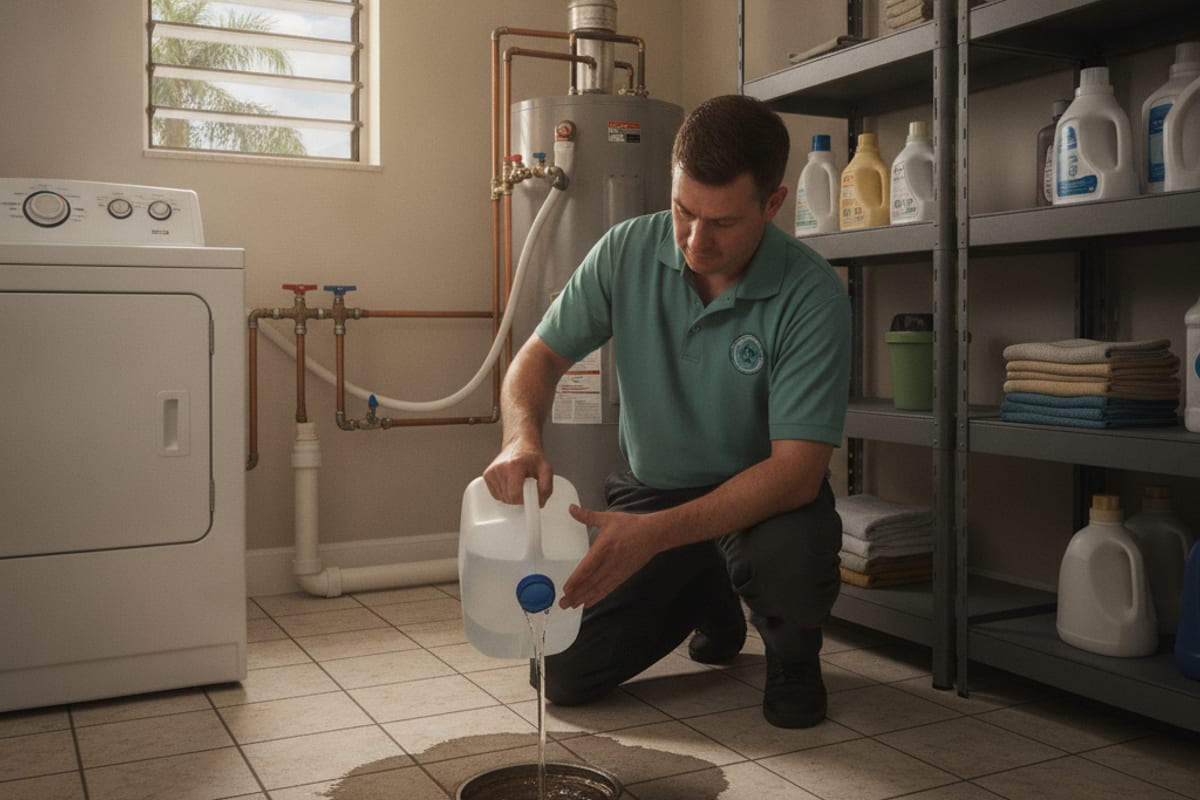
The fix is to run water down every drain in the house for thirty seconds, including ones you never touch. Pour a gallon into floor drains, since they hold more. If the smell fades over the next day, that was it.
For a drain you truly never use, add a couple of tablespoons of mineral oil after refilling it. The oil floats and slows evaporation for months. Put a recurring reminder on your phone for the drains in a vacation property.
Check the toilet’s wax ring
If the smell is strongest in one bathroom and lives near the floor, suspect the wax ring. That’s the seal between the toilet’s base and the drain flange.
Signs it’s failing:
- The toilet rocks slightly when you shift your weight
- Discolored or soft flooring at the base
- The smell gets noticeably worse right after a flush
- Caulk around the base has separated
Wax rings dry, compress, and eventually stop sealing. On the slab foundations that dominate Tampa Bay construction, a toilet that has been reset even slightly out of position wears its ring unevenly and fails sooner.
The ring itself is a few dollars. The labor is pulling the toilet, scraping the old wax, and setting it back on a new one. It’s a routine toilet repair job. Worth doing promptly, because a leaking seal is also putting water under your flooring.
Look at the vent stack
Your drain system needs air. Vent pipes run up through the roof so that water flowing down a drain pulls air in behind it instead of siphoning the water out of nearby traps.
When a vent blocks, every trap on that branch gets sucked dry, and you get sewer smell in multiple rooms at once.
The tell is sound. If a sink gurgles when a nearby toilet flushes, or you hear a slurp from the shower when the washer drains, air is coming from somewhere it shouldn’t. That’s a vent problem, not a clog.
Around here vents block from leaf litter, palm debris, wasp and bird nests, and the occasional squirrel. Homes under heavy live oak canopy in Hyde Park, South Tampa, and the older St. Pete neighborhoods collect the most. This is roof work with a drain snake fed downward, so it’s not a DIY job for most people.
Cast iron corrosion, the expensive answer
If your house predates roughly 1975, your drain lines are probably cast iron. Fifty-plus years in Florida soil is a long service life, and a lot of Tampa Bay’s original cast iron is at the end of it.
Cast iron fails from the inside out. Waste sits in the bottom of the pipe, corrosion eats the base of the wall, and eventually you get pinholes and then open cracks along the bottom of the run. Gas escapes through those into the slab, the crawlspace, or the wall cavity, and works its way up into the living space.
What points to this rather than a trap:
- The smell is diffuse and hard to localize, or seems to come from walls or the floor generally
- It’s worse in humid weather or after heavy use
- Multiple drains are also running slow
- Refilling every trap in the house changed nothing
- The house is pre-1975 and has never been repiped
You cannot confirm this by smell. It takes a camera in the line. A sewer line inspection shows the pipe wall condition directly and tells you whether you’re looking at a spot repair or a section replacement. Getting that answer before you spend money on anything else is the right sequence, because homeowners regularly replace three wax rings chasing an odor that turns out to be a cracked lateral.
If that’s where you land, our write-up on cast iron pipe failure in older Tampa Bay homes covers what repair and replacement actually involve.
If you’re on septic
Much of Pasco County and rural Hillsborough runs on septic. On those systems a sewer smell has two extra possible sources.
A tank that’s overdue for pumping pushes gas back toward the house. Typical pumping interval is every three to five years depending on tank size and household count.
The other is drainfield saturation, and it’s seasonal here. During the summer rain pattern, when the water table comes up and afternoon storms run for days, a marginal drainfield stops accepting effluent. You’ll usually smell it outdoors over the field before you smell it inside, and the ground there may be soggy or unusually green.
Indoor smell plus a wet drainfield means the system is backing up, and that needs septic service rather than any indoor fix.
Narrowing it down quickly
Work in this order and you’ll find most problems without paying anyone:
- Run every drain in the house, including floor drains. Wait a day.
- If the smell is in one bathroom near the floor, check whether the toilet rocks.
- If drains gurgle when other fixtures run, suspect the vent.
- If the whole house smells and step one changed nothing, and the house is pre-1975, get a camera in the line.
- If you’re on septic and the yard is wet over the field, call about the tank.
If you’ve worked through that and still have a smell, or the house is old enough that cast iron is on the table, we connect Tampa Bay homeowners with experienced local crews who can camera the line and tell you what’s actually happening. Reach us at (813) 590-0625.
Before any work begins, verify the plumber’s CFC license at myfloridalicense.com. It’s public record and takes a minute to check.