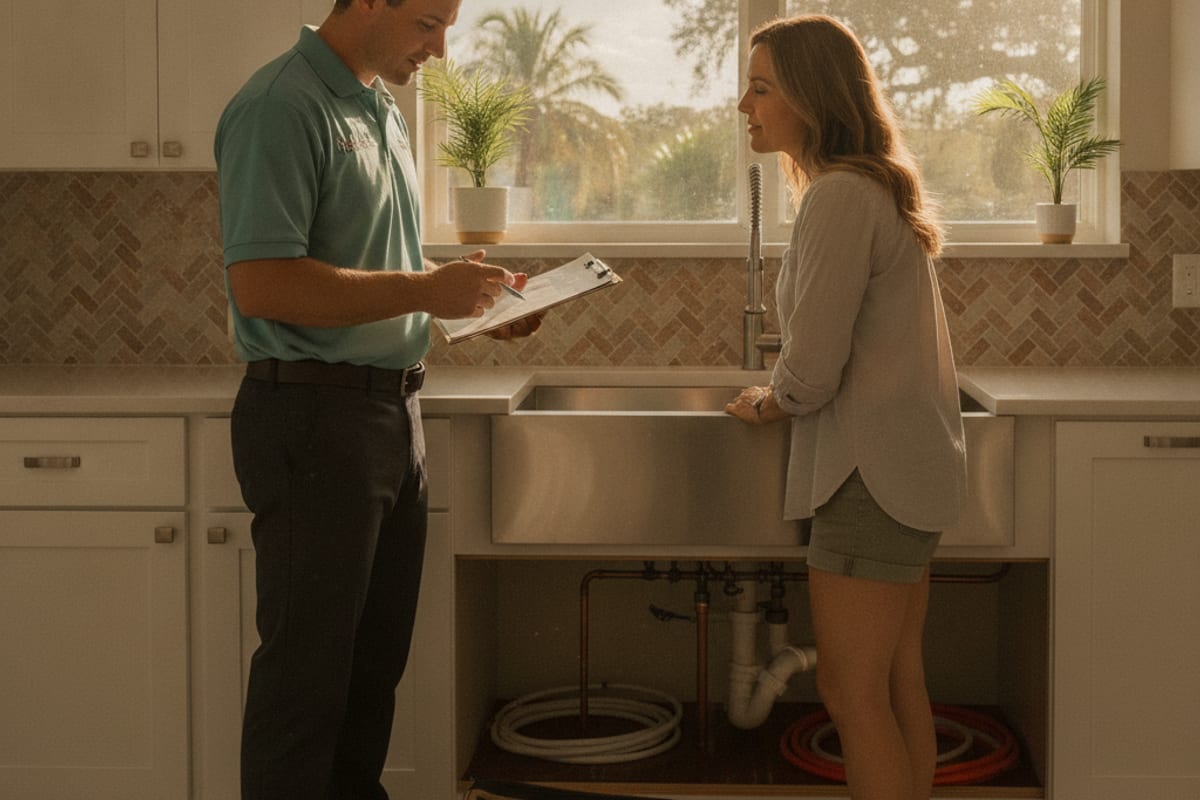
Most homeowners only look up plumbing repair costs once something has already gone wrong, a running toilet, a slow drain, a mystery wet spot in the yard. The honest answer is that plumbing repair cost in Tampa varies a lot by what’s actually broken, but the ranges are more predictable than people expect once you know what’s driving them. Here’s what the most common repairs actually run in this market, what pushes those numbers higher here than in a lot of the country, and how to tell whether a repair or a replacement is the smarter call.
What drives plumbing repair costs in Tampa
Three things separate Tampa Bay plumbing repair costs from the national averages you’ll find on a generic search. First, our water is hard, averaging 11.7 grains per gallon and climbing past 17 in the dry season. That mineral load coats valves, flappers, heating elements, and pipe interiors, which means fixtures and water heaters here wear out faster than their rated lifespan suggests, and repairs come around sooner than a homeowner from a soft-water state would expect.
Second, housing stock varies enormously by neighborhood age. A 1920s bungalow in Seminole Heights or Hyde Park is still likely running original cast iron drain lines, while a 1985 ranch in Carrollwood or Town ‘n’ Country was probably built with polybutylene supply pipe, a material that fails from the inside with no warning. Both push repair frequency and cost up compared to a newer build in Brandon or FishHawk with PEX and PVC already in place.
Third, hurricane season adds real pressure to emergency and after-hours repair pricing between June and November, when storm surge, heavy rain, and power outages all stress a home’s plumbing at once and every crew in the metro is booked solid.
Common plumbing repairs and what they actually cost
Toilet repair. A standard toilet repair, replacing a flapper, fill valve, or flush valve, typically runs $125 to $250 including parts and labor. If the tank or bowl itself is cracked, a full installation runs $300 to $550 instead. On a replacement, check whether you qualify for a toilet rebate through your Tampa Bay utility first, since it can return $40 to $200 of that. Hard water is the usual culprit behind a toilet that runs constantly, since mineral scale keeps the flapper from sealing against the flush valve seat.
Water heater repair. Most water heater repairs run $150 to $450 depending on the part. A thermostat or heating element swap sits on the lower end, while a gas control valve or thermocouple replacement runs closer to $350 to $450 with labor. A full tank replacement, 40 to 50 gallons, typically runs $1,400 to $2,600 installed.
Drain clearing. Clearing a single clogged fixture, a sink, tub, or shower drain, usually runs $150 to $350. Main line jetting for a whole-house clog runs higher, $350 to $700, and most jobs finish inside an hour once a technician is on site.
Leak detection. Finding a hidden leak, especially a slab leak, runs $250 to $450, and that fee typically applies toward the repair itself if you move forward. Most leaks get located in a single visit using acoustic and thermal equipment rather than guesswork.
Faucet and fixture repair. Swapping a worn faucet, garbage disposal, or fixture runs $150 to $300 in labor, not counting the cost of the fixture itself, and most jobs finish same-day. See our faucet repair guide for which part is usually the actual culprit.
Sewer line repair. This is where costs jump the most. A localized sewer line repair using trenchless pipe lining for a cracked or root-intruded joint typically runs $2,500 to $6,000. A full sewer line replacement runs considerably more, often $6,000 to $15,000 depending on length and whether trenchless methods are viable for your lot. A camera inspection to diagnose the problem first runs $200 to $400 and usually applies toward the repair cost.
Repair or replace: how to tell
The age and pattern of the problem matters more than the sticker price of either option. A single, isolated failure, one bad flapper, one worn heating element, one leaking fitting, is almost always worth repairing regardless of the fixture’s age, since the fix is cheap relative to full replacement. The calculus shifts once you’re looking at multiple failures on the same fixture within a short window, visible corrosion or rust at the source, or a unit that’s already past its realistic lifespan in Tampa’s hard water, generally 8 years or older for a water heater, 50-plus years for cast iron sewer lines. At that point, a second repair often just delays a replacement you’re going to need anyway, and the honest recommendation is usually to handle it once rather than twice.
What pushes repair costs higher during hurricane season
Between June and November, plumbing failures spike alongside the weather. Storm surge in low-lying areas of St. Petersburg and along the Gulf beaches can push seawater and debris back into sewer laterals. Heavy rain saturates ground around aging sewer lines and accelerates root intrusion in older neighborhoods. And when a named storm is approaching, every plumbing company in the metro fields a surge of emergency calls at once, which means after-hours and same-day service premiums are more common during peak season than in a quiet October. A standard emergency service call typically runs $150 to $300 before repair costs, with the repair itself priced separately once a technician diagnoses the problem. Booking a non-emergency repair before storm season, rather than during it, is one of the simplest ways to avoid paying a rush premium for a problem you already knew about.
How to vet the crew you hire
Florida requires a CFC plumbing license for anyone performing plumbing work in the state, and it’s worth confirming that credential before anyone starts work in your home. You can verify any plumber’s CFC license status directly at myfloridalicense.com in under a minute, and it’s a habit worth building regardless of who you call, us included. Ask for a written scope and price before work begins, not after, and be wary of any quote that seems far below the ranges above for a comparable job. A price that low usually means a part is being skipped or a shortcut is being taken somewhere you won’t see until later.
How much does a typical plumbing repair cost in Tampa?
Most single-fixture repairs, a toilet, a faucet, a drain clog, run $125 to $350. Larger jobs like water heater replacement or sewer line repair run into the thousands, but the majority of service calls fall in that lower range.
Is it cheaper to repair or replace an old toilet?
Repair is cheaper upfront, usually $125 to $250 versus $300 to $550 for a new install. But if the tank or bowl is cracked, or you’ve already paid for two separate repairs on the same unit within a year, replacement is the better long-term value.
Why do plumbing repairs cost more during hurricane season?
Demand spikes across the whole metro at once between June and November, storm surge and heavy rain stress older sewer lines and low-lying properties, and after-hours emergency calls carry a service premium that a scheduled daytime repair doesn’t.
How do I know if a plumber I’m hiring is legitimate?
Check their CFC plumbing license at myfloridalicense.com before any work starts, get a written price before the job begins, and treat a quote that undercuts the typical range by a wide margin as a red flag rather than a deal.
If you’re looking at a repair anywhere in Tampa, St. Petersburg, Clearwater, or the surrounding suburbs and want a straight number before you commit to anything, call Tampa Plumbing Pro at (813) 590-0625. We’ll diagnose the actual problem and give you honest pricing for repair against replacement before any work starts.