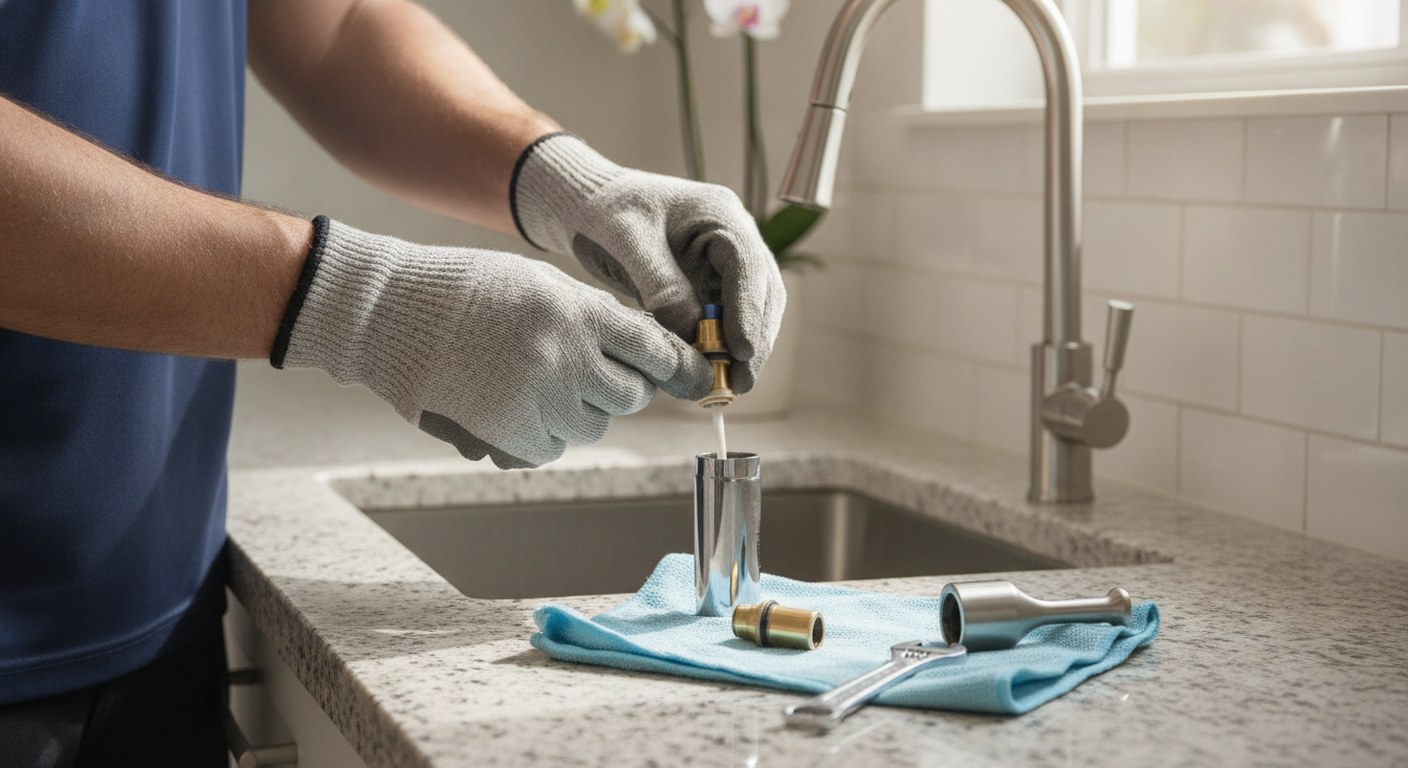
A dripping faucet in a Tampa Bay home comes down to one of four things: a worn washer or cartridge, mineral scale from hard water sitting inside the valve, a bad O-ring at the handle, or a shutoff valve underneath that’s no longer sealing. Which one it is depends on where the drip is actually coming from, not just that it’s dripping.
That’s the part most guides skip, and it’s the difference between a $10 part and a $300 callback.
Find the drip before you fix anything
Drip from the spout when the faucet is fully off points to the valve itself, a worn washer in an older compression faucet or a scored cartridge in a newer one. Water pooling at the base of the handle is almost always an O-ring, not the valve. Water under the sink cabinet is a supply line or shutoff valve, not the faucet at all, and that one shouldn’t wait.
Two-handle faucets in older Tampa Bay homes, common through Seminole Heights and the historic cores of St. Petersburg, usually use rubber washers and compression stems. Single-handle kitchen and bath faucets from the last 20 years almost always use a cartridge or a ceramic disc valve instead. The repair is different for each, so knowing which one you have before buying parts saves a second trip to the hardware store.
Hard water is why it comes back so fast here
Tampa Bay water runs 11 to 17 grains per gallon of hardness in most of the metro, and that mineral load is the reason a faucet repair here doesn’t hold as long as the same repair up north. Scale builds inside the valve seat and on the cartridge itself, so even a freshly replaced washer can start dripping again within a year or two as new scale accumulates on top of it.
This is also why a straight washer-for-washer swap sometimes just buys a little time. Ceramic disc cartridges resist scale better than rubber washers or older brass cartridges, so if a faucet is already on its second or third repair, upgrading the cartridge type is usually the better move instead of repeating the same fix. If scale is bad enough to keep wrecking cartridges every year or two, a whole-home water softener addresses the cause instead of just the symptom.
What it actually costs to fix
| Job | Typical Tampa Bay cost | Time |
|---|---|---|
| DIY washer or O-ring replacement | $5 to $15 in parts | 20 to 40 minutes |
| Professional cartridge or valve replacement | $150 to $300 in labor | Same-day, most jobs |
| Shutoff valve replacement (if corroded) | Add $50 to $100 per valve | Same visit |
| Full faucet replacement | $150 to $300 labor plus the fixture | Same-day |
A basic two-handle compression faucet is one of the more forgivable DIY repairs in plumbing: shut off the water, pull the handle, swap the washer, done. A single-handle cartridge faucet is less forgiving, since the wrong cartridge for the brand and model won’t seal correctly no matter how carefully it’s installed, and taking the handle apart on a model you don’t recognize risks cracking a plastic retaining clip that’s no longer sold separately.
When it’s not actually the faucet
If the drip is coming from underneath the sink instead of the spout or handle, stop and check the shutoff valve and supply line connections first. Corroded shutoff valves are common in older Seminole Heights and St. Petersburg homes that still have their original valves, and a valve that’s stuck, weeping, or won’t fully close needs replacing, not tightening. Installing a new faucet on a failing shutoff valve just moves the leak from the faucet to the cabinet floor.
Low flow isn’t the same problem as a leak
A faucet that seems weak but isn’t dripping is a different issue entirely, and it’s often not a problem at all. Every kitchen and bathroom faucet sold since the mid-1990s is capped by federal standard at 2.2 gallons per minute, and WaterSense-labeled bathroom faucets are capped lower still, at 1.5 gpm. If a faucet feels weaker than it used to but doesn’t leak, the aerator screen at the tip is the first thing to check. Hard water sediment clogs that screen faster here than in most of the country, and unscrewing it for a rinse is a two-minute fix that solves most “weak faucet” complaints before anyone assumes the faucet itself has failed. That’s a separate issue from whole-house low water pressure, which points to the supply side of the plumbing rather than one fixture’s aerator.
Frequently asked questions
Why does my faucet keep dripping even after I replace the washer?
If it starts again within a year, Tampa Bay’s hard water is usually the reason. Mineral scale keeps building on the new washer or cartridge the same way it built on the old one, so a repair here doesn’t last as long as it would with softer water. Switching to a ceramic disc cartridge, which resists scale better than rubber washers or standard brass cartridges, usually holds up longer than repeating the same fix.
Can I fix a dripping faucet myself?
A two-handle compression faucet is one of the easier DIY plumbing repairs: shut off the water under the sink, pull the handle, and swap the washer for around $5 to $15 in parts. Single-handle cartridge faucets are less forgiving, since the wrong cartridge for the brand won’t seal properly and the internal clips are easy to crack on a model you’re not familiar with.
How much does professional faucet repair cost in Tampa?
Professional cartridge or valve replacement typically runs $150 to $300 in labor, not including the cost of the fixture if a full replacement makes more sense. Add $50 to $100 per valve if a corroded shutoff valve underneath needs replacing at the same time, which is common in older Tampa Bay homes.
My faucet drips from underneath, not the spout. Is that different?
Yes, and it’s more urgent. A drip at the spout or handle is the faucet itself. Water appearing under the sink cabinet is almost always a supply line connection or a failing shutoff valve, and that can damage the cabinet or subfloor if it sits unnoticed. That’s emergency plumbing territory, not a wait-and-see repair.
My faucet feels weak but isn’t leaking. Is that a repair or normal?
Check the aerator screen first. Federal and WaterSense flow standards already cap faucet output at 2.2 gpm or lower, and hard water sediment clogs that screen faster in Tampa Bay than almost anywhere else. Unscrewing and rinsing the aerator solves most weak-flow complaints. If the whole house feels weak, not just one faucet, that’s a different problem worth checking separately.
Should I repair or replace an old faucet?
If it’s on its second or third repair, or if it’s an original 1960s-70s fixture in an older home, replacement usually costs about the same as another repair and comes with a cartridge type built to handle Tampa Bay’s water going forward. A faucet that’s dripped once and is otherwise in good shape is usually worth just repairing.
Get the right fix the first time
The licensed plumber we match you with checks the drip location, the valve type, and the shutoff valve before quoting anything, so you’re not paying for a repair that fails again in six months. Whether it’s a $10 washer or a full fixture swap, you’ll know which one you actually need.
Call Tampa Plumbing Pro at (813) 590-0625 and we’ll match you with a licensed plumber for the repair.