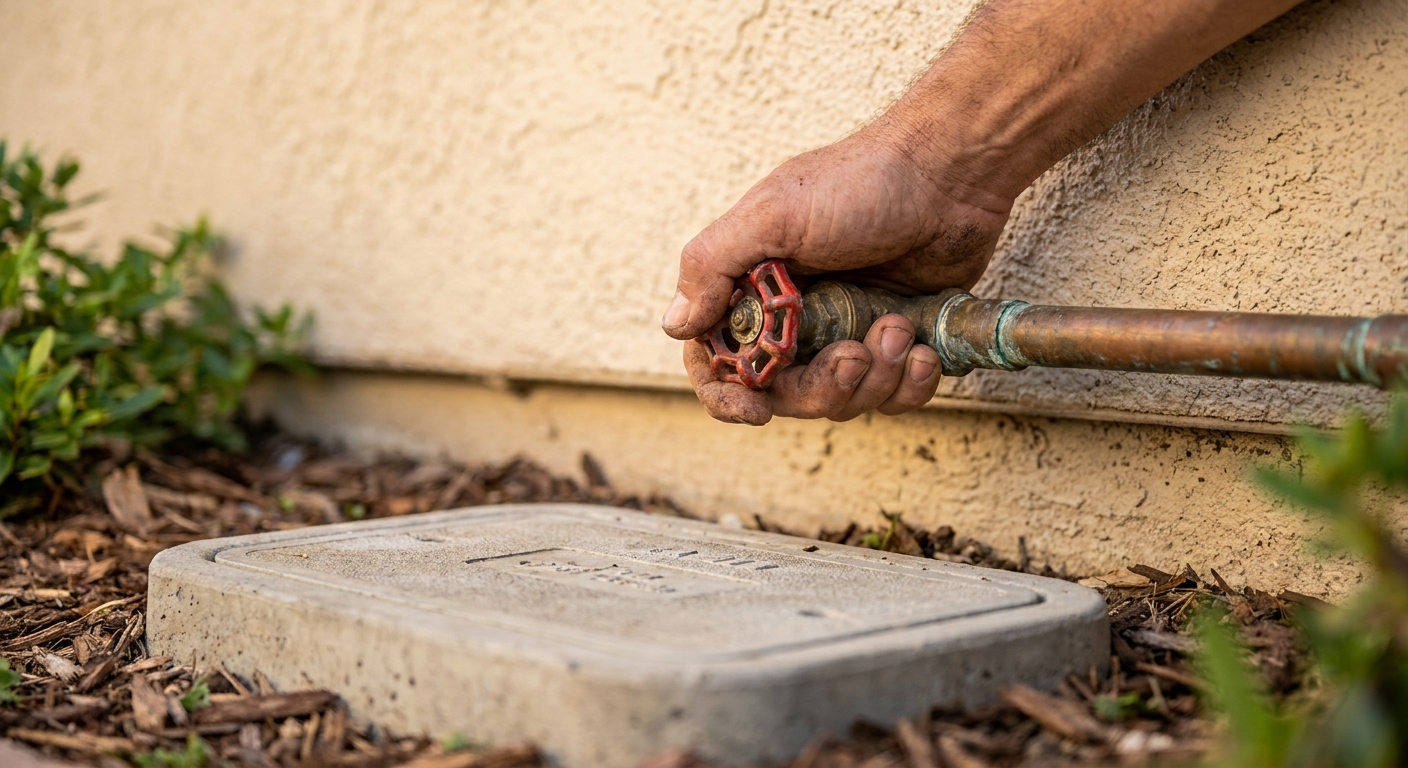
A burst pipe can spread water fast, but your safety comes first. If water is near outlets, wiring, appliances, or an electrical panel, or you smell gas, move everyone away and contact emergency services or the appropriate utility from a safe location. Only when the area is safe should you gently close a known, accessible, home-owned shutoff, then call us to be matched with a licensed local plumber.
Find your shutoffs before you need them
Don’t wait for an emergency to figure out where your shutoffs are. Walk your house today and locate three things: the main shutoff valve, the fixture shutoffs under sinks and toilets, and the water heater shutoff. In a lot of homes built in the polybutylene era around Carrollwood, Town ‘n’ Country, and New Tampa, these valves haven’t been touched in years and may be stiff or even seized. Test them now, gently, so you’re not fighting a frozen valve while water is spreading across your floor.
The main shutoff valve
Your main shutoff is the fastest way to stop water to the entire house. In most Tampa Bay homes on slab foundations, it’s located in one of a few common spots: near the water meter at the edge of your property line, in a garage or utility closet, or occasionally in an outdoor box near the front hose bib. Homes in Hillsborough and Pinellas built before the 1990s sometimes have the main valve buried under landscaping that’s grown up around it over the decades, especially in older neighborhoods like Seminole Heights, Hyde Park, and St. Petersburg’s Old Northeast.
To shut it off, turn the valve clockwise (righty-tighty) until it stops. Gate valves need several full turns. Ball valves, which are more common in newer installs, only need a quarter turn to fully close. If the handle won’t budge, don’t force it hard enough to snap the stem. If the valve is stuck, stop and get help from a licensed plumber.
The water meter shutoff
If your home-owned main valve is missing, blocked, or broken, contact the utility shown on your water bill. Don’t open the meter box or operate the utility-owned shutoff unless that utility confirms its procedure. City of Tampa Water, Hillsborough County Public Utilities, and Pinellas County Utilities treat meter equipment as theirs. Unauthorized operation can be treated as tampering. Call the number on your bill and ask them to walk you through their emergency shutoff process.
Continued water use with every fixture and appliance off can suggest a leak, but it doesn’t reveal the location. Ask your utility to check its equipment, then have a licensed plumber trace any problem on the private supply side. Our guide explains water-line repair in Tampa Bay.
Shutting off a single fixture
Most of the time, you don’t need to kill water to the whole house. A toilet overflowing, a supply line under a bathroom sink failing, or a washing machine hose bursting can usually be handled at the fixture level.
Toilets: Look for a small oval valve on the wall or floor behind the toilet, on the water line running up to the tank. Turn it clockwise until snug.
Sinks: Under every sink there should be two shutoff valves, one for hot and one for cold, right where the supply lines meet the wall. Turn both clockwise.
Washing machines: Two valves, usually mounted on the wall behind the machine, control hot and cold supply. These get overlooked constantly and are a common source of slow, hidden leaks in laundry closets in condo units around Clearwater Beach and St. Pete Beach. If the water is coming from the drain side instead, start with our guide to a washing machine drain overflow.
Water heater: There’s a shutoff valve on the cold water inlet line at the top of the tank, or on the supply line for a tankless unit. Turning this off stops water from continuing to feed the tank if it’s leaking, and buys time until water heater repair arrives. Shut off the unit’s power or gas before its water, and see how to find where a water heater is leaking from for the full sequence.
What to do after the water’s off
After the flow stops, and only if there’s no gas smell or electrical hazard, open a low faucet or outdoor spigot to relieve pressure. If you smell gas or see water near an outlet, appliance, wiring, or electrical panel, move away and get everyone out of the affected area. Contact emergency services or the appropriate utility from a safe location. Don’t touch switches, plugs, panels, or wet equipment.
After safely stopping the water, photograph the damage and begin drying wet areas and items when it’s safe. The EPA recommends drying them within 24 to 48 hours to help prevent mold growth, but that window isn’t a guaranteed mold-onset time. Extensive damage or water contaminated by sewage calls for an experienced cleanup professional.
Why this matters more in Tampa Bay specifically
A lot of Tampa Bay shutoffs haven’t been touched in years. In polybutylene-era homes around Carrollwood, Town ‘n’ Country, and New Tampa, fixture valves and the main shutoff can be stiff or seized, so a gentle test on a dry day beats fighting a frozen handle while water is spreading. In older Hillsborough and Pinellas neighborhoods like Seminole Heights, Hyde Park, and St. Petersburg’s Old Northeast, the main valve is sometimes buried under landscaping that grew up around it. Find that home-owned valve now. If it is missing, blocked, or broken, call the utility on your water bill rather than opening the meter box yourself.
Check the pipe, not the construction age
A home’s construction age can’t diagnose its pipe material. If you see unfamiliar pipe, staining around fittings, or active leakage, don’t force a stiff shutoff. Have a licensed plumber identify the visible material, account for hidden runs and past repairs, and inspect the valve before recommending a repipe.
Save our number now
Save (813) 590-0625 now, and keep our emergency plumbing service page before you need it. Tampa Plumbing Pro can match you with a licensed local plumber serving Hillsborough, Pinellas, or Pasco when one is currently available. If water is still flowing, operate only a known, accessible home-owned shutoff gently while you request help.
A quick note on outdoor spigots and irrigation
Don’t forget your irrigation system has its own backflow preventer and shutoff, usually near where the line leaves the house. If a sprinkler line or outdoor spigot is the source of your leak, you likely don’t need to touch the main house valve at all, just isolate that one line and you’ll keep water running everywhere else in the house.