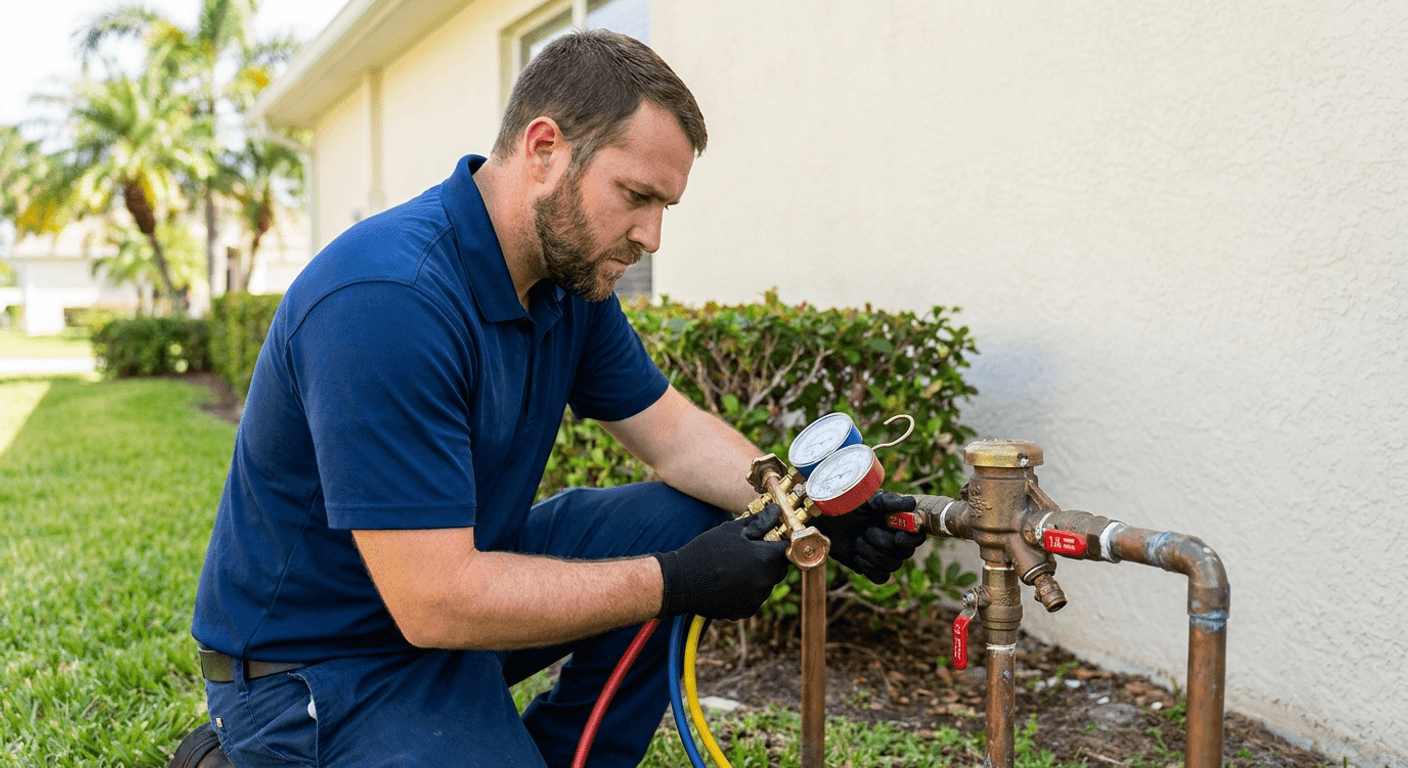
Backflow testing in Tampa Bay isn’t one rule. It’s four, and they don’t agree with each other. The City of Tampa tests residential devices every two years and commercial ones annually. Hillsborough County requires annual testing on every assembly it oversees. Pasco County also tests annually, and gives you 10 days to fix a failure. Pinellas County doesn’t publish a testing frequency at all.
Which set applies to you depends on which utility bills you for water, not on what your mailing address says. That’s the part national guides get wrong, because almost all of them just say “annually” and leave it there.
What backflow is, and why Florida regulates it
Backflow is drinking water reversing direction and flowing backward into the public supply. It happens two ways. Pressure in the city main drops, which siphons water backward out of your house. Or pressure on your side climbs higher than the main and pushes water back the other way.
That matters here because of what’s connected to the water in a typical Tampa Bay yard. In-ground irrigation lines sit in soil carrying fertilizer and pesticide. Pools hold chlorinated and stabilized water. Fire sprinkler systems hold water that’s been standing in pipe for years. Reclaimed water lines run through a lot of this metro. A backflow preventer is the one-way valve that keeps all of that out of the drinking supply, and the test confirms the valve still actually closes.
The reversal risk isn’t theoretical after a storm. When municipal pressure drops during a major hurricane event, that pressure loss is exactly the condition that pulls water backward, which is part of why boil-water notices follow big storms. Our hurricane season plumbing prep guide covers the rest of the storm checklist.
One clarification worth making, because these two things get mixed up constantly. A backflow preventer sits on your clean water supply and keeps contamination out of the drinking system. That’s the device this article is about, and it’s the one your utility wants tested. A backwater valve, sometimes called a sewer backflow valve, sits on your main sewer line and keeps sewage from pushing back into the house during a storm. Both are worth having in this metro. Only the first one gets a testing notice.
Backflow testing in Tampa Bay: the rules by utility
Here’s what each of the four major water providers in this metro requires. Verify against your own utility, since service areas don’t follow county lines cleanly and the provider on your bill is what governs you.
| Utility | Testing frequency | Where results go | If the device fails |
|---|---|---|---|
| City of Tampa | Residential every 2 years, commercial annually | SwiftComply, within 7 calendar days of the test | Service or replace within 15 days, then retest |
| Hillsborough County | Annually, all assemblies | Backflow BMP portal | Notify the county within 48 hours |
| Pasco County | After install or repair, then annually | Email the county’s own test report form to its backflow program | Repair or replace within 10 days |
| Pinellas County | Not published on its assembly page | Confirm with Pinellas County Utilities | Confirm with Pinellas County Utilities |
Three of those four deadlines are different numbers. If you own property in both Tampa and unincorporated Hillsborough, which plenty of local landlords do, you’re on two different clocks with two different portals.
The City of Tampa also runs on a notice system. When the city sends you a testing letter, you have 30 days from receiving it to get the device tested. The clock starts at the letter, not at the anniversary of your last test.
Do you even have a backflow preventer?
Most single-family homes on city water don’t have a testable assembly, and plenty of homeowners get a notice and have no idea what it’s about.
In the City of Tampa, devices are required on connections flagged as having backflow potential. That covers all commercial, industrial, and multi-family residential properties, plus any property with a fire sprinkler system, a swimming pool, or an in-ground irrigation system. Reclaimed water connections and secondary water supplies are on that list too.
Pasco County splits it by device type. Commercial properties need a reduced pressure assembly right after the water meter. Most residential properties there use a dual check device instead, which is a simpler part. Fire suppression systems need their own assembly type.
Pinellas County requires assemblies on commercial properties, properties with reclaimed water available, firelines at designated properties, and participants in its Alternate Water Sources Rebate Program.
The practical read: if you have a pool, an irrigation system, reclaimed water, or a fire line, assume you have a device and assume somebody wants it tested.
What the state rule sets as the floor
Florida Administrative Code 62-555.360 is the statewide baseline, and it’s where the every-two-years number comes from.
Under that rule, assemblies at non-residential service connections get tested after installation or repair, then at least annually. Assemblies at residential connections get tested after installation or repair, then at least every two years. Dual check devices get refurbished or replaced every 5 to 10 years rather than tested on that cycle. Air gaps get inspected at least annually.
Your utility can be stricter than the state floor, and Hillsborough County is. It requires annual testing on every assembly rather than splitting residential onto the two-year cycle. Nobody can be looser than the floor, which is why “every two years” is the least frequent testing you’ll see quoted anywhere in Florida for a residential assembly.
Who’s actually allowed to test it
A plumbing license and a backflow tester certification are two different credentials. Your regular plumber may hold both. Many hold only the first.
Every utility here requires the test be done by a certified backflow prevention device technician using a test kit with current calibration. Hillsborough County adds a second requirement on top: the tester has to be registered with Hillsborough County specifically, not just certified somewhere. A tester who’s perfectly qualified in Pasco can’t submit a Hillsborough test until they’re registered in that county’s system.
Pasco draws a further line between testing and fixing. Testing needs a certified assembly tester. Repairs and installations need a state-licensed plumbing contractor holding both the tester and the repair certifications. Fire system work there needs a licensed fire sprinkler contractor instead.
Before you book anyone, ask two questions: are you certified to test, and are you registered with my specific utility. If the answer to either is no, the test won’t count even if the device passes.
What happens when a device fails
A failed test isn’t a fine. It’s a countdown, and the length of it depends on your utility.
Tampa gives you 15 days to service or replace the device, then retest and resubmit the result. Pasco gives you 10 days to repair or replace. Hillsborough wants notification within 48 hours of the failure, and the property owner carries responsibility for the repair or replacement either way.
Worth being straight about one thing: none of these four utilities publishes a specific penalty schedule on the pages covering their testing programs. We’re not going to tell you what the fine is, because they don’t say. What they do say is that the device has to be fixed and retested on a short clock, and that’s the part worth planning around.
What backflow work costs around here
Testing fees vary by provider, so ask for the number when you book rather than trusting a range you read online.
Device service or replacement is the cost that actually bites. In our experience across this metro that runs roughly $200 to $600, depending on the size and type of the assembly. A small residential dual check sits at the bottom of that. A larger reduced pressure assembly on a commercial meter sits at the top.
Pinellas County also bills a recurring assembly charge on top of any testing, published as a bimonthly line item: $3.18 for a residential assembly under one inch, $11.67 for a commercial or small fireline assembly under two inches, and $30.83 to $31.67 for larger commercial and multi-family assemblies over four inches. That’s a utility charge, not a plumber’s charge, and it shows up whether anything needs work or not.
Where this overlaps with the rest of your plumbing
A backflow assembly is a valve exposed to weather, and in this climate that means it corrodes. Brass fittings near the coast take salt air badly, which is the same reason outdoor spigots and hose bibs fail early in waterfront areas like Clearwater.
If you’re on a private well anywhere in Pasco or the rural Hillsborough fringe, cross-connection is a live concern rather than a paperwork item, especially if any part of the property also touches a municipal or reclaimed line. Our guides to well water treatment in Pasco and well pump repair cover that side of it, and a failing pump or pressure tank changes the pressure conditions that make backflow possible in the first place.
If a device fails and water has already reversed, that’s a contamination event rather than a maintenance item, and it’s worth treating as emergency plumbing rather than waiting for a scheduled visit. Knowing where your main shutoff is matters more in that moment than knowing your test date. If you suspect water is moving where it shouldn’t but can’t find it, that’s a leak detection call.
Frequently asked questions
How often does Tampa require backflow testing?
The City of Tampa tests residential devices every two years and commercial devices annually. If the city mails you a testing notice, you have 30 days from receiving that letter to get the device tested, and your tester has 7 calendar days from the test date to submit the result through SwiftComply.
Is Hillsborough County’s rule different from the City of Tampa’s?
Yes, and this catches people. Hillsborough County requires annual testing on every backflow assembly, with no two-year residential cycle. It also requires the tester be registered with Hillsborough County specifically, and it wants notification within 48 hours if an assembly fails a test.
Does my house need a backflow preventer at all?
Most single-family homes on city water don’t have a testable assembly. You’re likely to have one if your property has an in-ground irrigation system, a swimming pool, a fire sprinkler system, a reclaimed water connection, or a secondary water supply. Commercial, industrial, and multi-family properties are covered regardless.
Can any licensed plumber test my backflow preventer?
No. Testing requires a certified backflow prevention device technician with a currently calibrated test kit, which is a separate credential from a plumbing license. Some utilities add their own registration requirement on top, so ask whether the tester is registered with your specific water provider before booking.
What happens if my backflow device fails the test?
You repair or replace it on a short clock, and the length depends on your utility. Tampa allows 15 days to service or replace and then retest. Pasco allows 10 days. Hillsborough wants to hear about the failure within 48 hours. In all three, the property owner is responsible for getting it fixed.
How much does backflow service cost in Tampa Bay?
Service or replacement of a device typically runs $200 to $600 depending on the assembly’s size and type, with small residential dual checks at the low end and larger commercial assemblies at the high end. Testing fees are set by whoever performs the test, so ask when you schedule.
Get the device sorted before the notice shows up
The homeowners who find this stressful are the ones who open a utility letter, learn they have 30 days, and start from zero. The ones who don’t are the ones who already know what’s on their meter.
Tampa Plumbing Pro works across Hillsborough, Pinellas, and Pasco, so we deal with all three of these rulebooks regularly rather than knowing one of them well. We answer the phone 24 hours a day. If you’ve got a notice in hand, a device that failed, or you just want to know whether that brass thing by your meter is even a testable assembly, call us at (813) 590-0625 and we’ll tell you what your utility actually requires.
Sources: City of Tampa backflow testing, Hillsborough County backflow and cross-connection testing, Pasco County backflow and cross-connection control, and Pinellas County backflow prevention assembly charge. Florida Administrative Code 62-555.360 sets the statewide minimum.