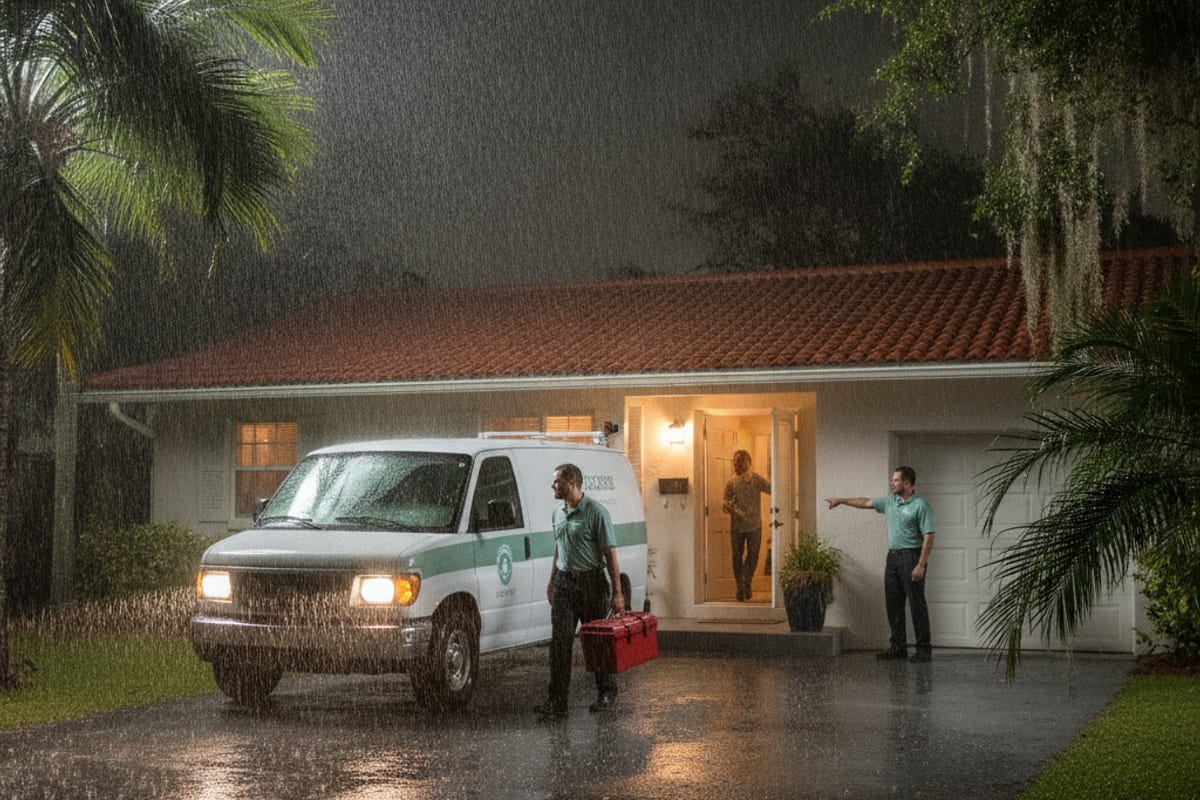
The worst time to figure out what counts as a plumbing emergency is at midnight on a Saturday when something is actively failing. The line between “this can wait until Monday” and “this needs attention right now” isn’t always obvious, especially in a climate like Tampa’s where heat, humidity, and heavy rain all conspire to accelerate pipe failure and flooding. Here’s how to draw that distinction, and what to do before a plumber arrives.
The one question that decides if it’s an emergency
Can water get into the house, damage the structure or contents, or compromise safety if you don’t address this in the next few hours? If the answer is yes, it’s an emergency. If the answer is no, it’s probably not.
A toilet that won’t stop running is annoying and wasteful, but it’s not going to damage your house by Tuesday morning. You can call during business hours Monday. A water line actively spraying under your sink, or water pooling in a crawlspace or basement, is going to cause expensive structural damage if you ignore it over a weekend. That’s an emergency, and it justifies a 24-hour call.
The difference comes down to active water damage risk in the next 6-12 hours. Everything else usually has time for a regular appointment.
Scenarios that actually need emergency service
Water actively leaking from a supply line. If you’ve got a visible spray under a sink, at a water heater, or any visible break in the line running to the house, that’s an emergency. You’re looking at potential water damage, mold risk, and structural compromise if the water continues soaking wood framing or drywall. Shutting off the main water valve at the curb buys you time to call for help.
A backed-up sewer line creating a plumbing backup inside the house. Sewage coming up through a shower, bathtub, or toilet isn’t just gross, it’s a health hazard. Depending on what backed up the line (roots, a clog, structural failure), the problem will get worse without treatment, and it can spread to multiple fixtures quickly. Sewer line repair emergencies can’t wait because the longer the backup sits, the more fixtures are affected.
A major pipe burst visible or underground, with water pooling in the yard, crawlspace, or basement. If the ground is soft and soggy above the line or you’ve got standing water in a crawlspace, the break is actively flooding the area. That damage compounds by the hour. Call immediately and shut off the main water valve while you wait.
The water heater is actively leaking and you’re seeing pooled water at its base. A slow drip might wait until morning, but if the tank is streaming water, you’re looking at potential flooding and the tank will need water heater repair or replacement either way. Getting a replacement installed quickly matters. If you’re trying to work out where the water heater is leaking from, the source usually decides whether it’s a part or the whole tank.
Complete loss of water pressure to the house. If the water just stopped entirely and it’s not a known main break in your neighborhood, something has failed at the meter or in your primary supply line. You can’t flush, can’t shower, can’t fight a fire. That warrants an emergency call.
Flooding in the basement or crawlspace with no obvious single source. Could be a broken underground line, could be poor grading during heavy rain, could be a failed sump pump. Either way, pooled water in a foundation space needs immediate attention to prevent mold and structural damage.
Situations that are urgent but usually not emergency
A slow leak under a sink that’s not actively dripping, discovered during a normal day, can usually wait for a next-day appointment. Put a bucket underneath and call in the morning.
A running toilet that’s wasting water but not overflowing can typically wait for business hours. It’s not damaging the house in the short term.
A clogged drain that’s slowing but not completely backed up usually doesn’t need an emergency call unless the backup is happening in the middle of a storm or you have a single bathroom serving multiple people.
A burst outdoor irrigation line discovered during the day is annoying but not an emergency unless it’s directly next to the house foundation and flooding the perimeter.
All of these deserve attention soon, but they don’t need to be 2 a.m. calls.
What emergency service costs in this market
After-hours plumbing costs more than a weekday appointment because a licensed plumber is leaving a night or weekend slot to take the call. The honest number depends on the hour, the travel, and what actually failed, so it has to be quoted rather than guessed from a blog. What you can count on is the other side of the ledger: water in framing, drywall, and flooring gets more expensive the longer it runs. If you’re unsure whether the failure is worth an after-hours match, call and describe it before we connect you with anyone.
What to do while waiting for the plumber
Shut off the main water valve. If water is actively spraying or pooling from a supply line, the main shutoff at the curb is your fastest damage control. Turn it clockwise until it stops. This immediately cuts off the water flow while you wait for help.
Move what you can. If water is pooling on a floor, move furniture, rugs, and personal items away from the wet area to prevent secondary damage.
Put down towels and buckets. Slow leaks can usually be managed with absorbent towels on the floor and a bucket underneath to catch drips. This buys time and contains the water.
Document the water damage with photos. For insurance purposes, take photos of what’s wet, what’s damaged, and the leak source if visible. This helps with claims later.
Don’t use the plumbing if it’s backed up. If sewage or dark water is backing up into a fixture, don’t flush the toilet or run the shower until the line is cleared. You’ll just make the backup worse.
FAQ
Is water coming out of the ceiling always an emergency? Yes. Active water from above usually means a burst or leaking line inside the wall or a roof leak pushing water into the structure. It needs professional attention immediately to prevent mold and structural damage.
Do I need an emergency plumber or can a general handyman handle this? Plumbing emergencies require a licensed plumber, especially anything involving supply lines, sewer backups, or water damage. Handyman-level fixes are fine for routine maintenance, but emergencies need licensing and expertise.
How fast can you actually get here if I call at 2 a.m.? Arrival time depends on who is available and where you are in the metro. We don’t publish a minute count because it would be a guess. Call (813) 590-0625, describe the failure, and ask for a current arrival window before you agree to an after-hours visit.
What if I’m not sure if it’s an emergency? Call and describe it. We can usually tell you over the phone whether it needs an after-hours match or a next-day appointment. It’s better to call and find out than to guess wrong and end up with water damage.
Call Tampa Plumbing Pro at (813) 590-0625 for after-hours matching. We connect Tampa Bay homeowners with licensed plumbers 24/7 for situations that can’t wait.