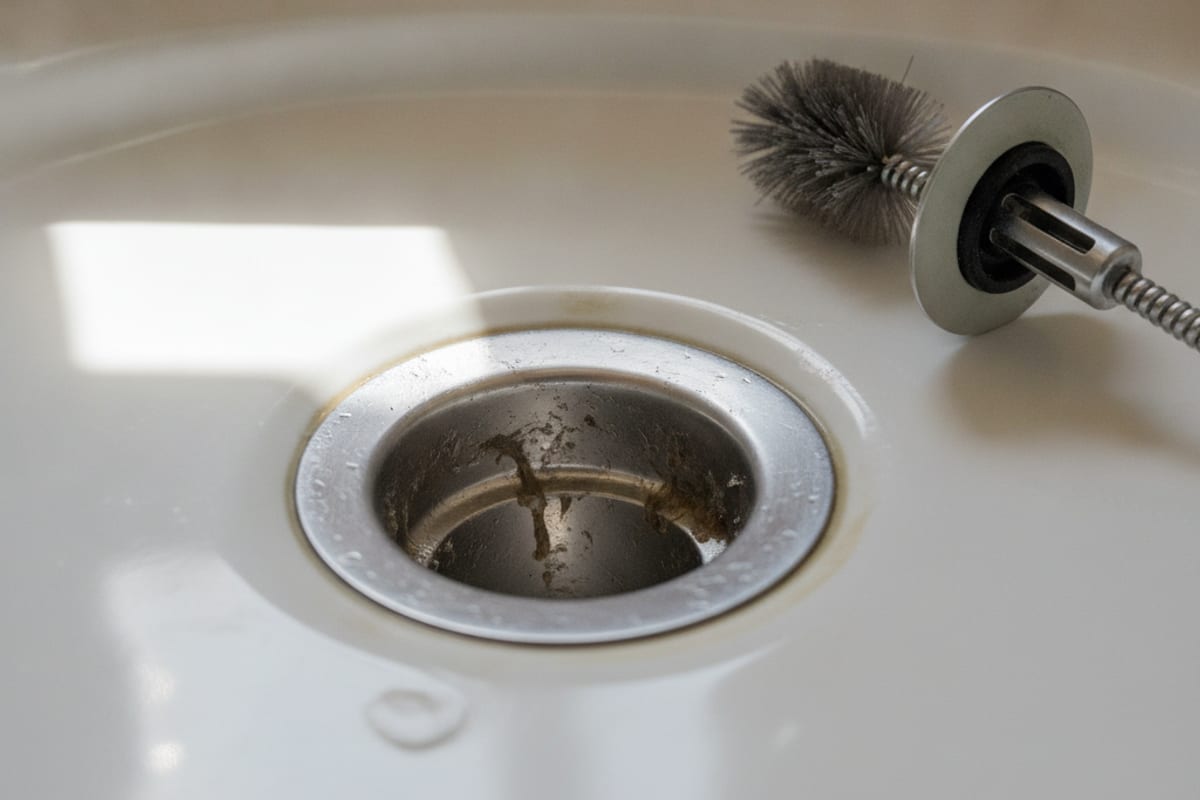
Drain flies are not a hygiene problem and they are not coming in from outside. They are hatching a few inches down one of your pipes, out of the wet organic film that coats the inside of a drain. Kill the adults and more show up, because the adults were never the infestation. Find the drain, scrub the film out of it, and they stop. The part that matters for a Tampa Bay home is what happens when you scrub every drain and they keep coming, because that points at a pipe that is wet where it shouldn’t be.
What you’re actually looking at
They are small, grey or tan, fuzzy, and shaped more like a tiny moth than a fly. They sit flat on the wall above a sink or a shower and barely move until you get close, and then they flutter rather than dart. Entomologists call them moth flies. The UF/IFAS Extension publication on Psychoda spp., EENY-716, is blunt about where they come from: the larvae “are found feeding on the film of wet organic material that can accumulate in drains.”
That film is the whole story. Hair, soap, skin, toothpaste and grease build a soft gelatinous layer on the inside wall of a drainpipe, usually in the first few inches below the strainer where the pipe is wet but not submerged. A female lays eggs in it. The eggs hatch, the larvae graze on the film, and adults crawl out of the drain a couple of weeks later. UC IPM describes the same mechanism, noting that “moth fly development often occurs in the slimy organic matter coating sink or shower drains”.
Warm weather speeds all of it up. UF publishes an egg hatch of “less than two days” at around 70°F, and a larval stage “lasting around nine to 15 days at 70°F (21°C), and as few as eight days at 85°F.” A warm Tampa Bay bathroom sits at the warm end of the range UF publishes, so the larval stage lands closer to the short figure than the long one.
Two things they are not. They do not bite, and UF states plainly that they “are not capable of transmitting any known pathogens.” The one health note the publication does make is narrow and worth keeping in its own scope: large infestations “can cause respiratory problems due to the possibility of inhaling fine hair-like scales.”
Find the drain before you clean anything
Almost everyone starts by cleaning the drain they can see flies near. That is a coin flip. Adults rest on a wall several feet from where they hatched, and a bathroom usually has two or three candidate drains, the sink and the tub or shower, and older Tampa houses add a floor drain or a laundry standpipe in the garage or utility room.
UC IPM publishes a source test that costs nothing. “Coat the inside of a cup or jar with Vaseline or vegetable oil and then invert the cup to cover the drain opening.” Do every drain in the room at once. “Traps should be placed over all drains within an infested room and left in place for 24 hours.” Anything hatching in that pipe crawls up, hits the greased wall and stays there. Clear tape stretched sticky-side-down over the opening works the same way and is easier to read at a glance.
Leave the traps a full 24 hours with the room otherwise undisturbed. The drain with flies stuck to it is your drain. Often it is the one nobody uses, the guest bathroom or a wet bar sink at the far end of the house. That is not a coincidence, and it matters for the next part.
Scrub it out, and skip the things that don’t work
Pouring bleach down the drain is the most common first move and it is close to useless here. UC IPM is direct about bleach and boiling water: they “do not remove the organic film within the drain; and they provide at best short-term control.” You are pouring a liquid through a tube whose walls are the problem. It runs past the film and down the line.
What works is mechanical. UF: “The simplest way to control drain flies is by manually removing the organic material in the drain where eggs are laid and larvae feed. This can be done by taking a metal pipe brush and scraping the inside of the drain.” UC IPM says the same thing in different words, pairing “a hard bristle brush with an industrial drain cleaner,” and adds that “regular use of an enzymatic drain cleaner may help to prevent the organic buildup.”
In practice that is a stiff bottle brush or a drain brush on a flexible stem. Pull the sink stopper assembly out first so you can get past it, then work the brush down through the strainer and against the pipe wall, all the way around, as far down as it will reach. Expect the brush to come out coated in black sludge. That sludge is the nursery.
Then keep the seldom-used fixtures wet. Every trap under a drain holds a plug of water that blocks sewer gas and keeps the line sealed. In a room nobody uses, that water evaporates, the trap opens, and the pipe below turns into open habitat. Running the guest shower and the spare sink for thirty seconds once a week is the single cheapest piece of drain-fly prevention there is. It is also the fix for a related complaint, which we cover in why your house smells like sewer.
Do not expect the room to clear the same day. Adults that already hatched are still flying, and UF puts the whole life cycle at “21 to 27 days”. A handful of stragglers in the first week is not a failed cleaning.
When it isn’t the drain, it’s the pipe
Here is the part that separates a housekeeping problem from a plumbing problem. If you tested every drain in the room, found the source, scrubbed it properly, and flies keep emerging a month later, or if the cup test came back empty on every drain and the flies are still there, the wet organic matter is somewhere you can’t reach with a brush.
UC IPM points the same direction, noting that a professional may need to inspect pipes in crawlspaces for “breaks or leaks if developing moth flies are not found in drains or other exposed locations.” Moth flies do not need much. Any spot where wastewater is sitting against soil or against the underside of a floor is a breeding site.
In Tampa Bay housing stock, the usual suspects are specific:
- A cracked drain line under the slab. A hairline crack in a horizontal run under an older Tampa Bay slab wets the sand beneath it continuously, and there is no way to reach that with a brush. It gets diagnosed with a camera, and it falls under sewer line repair.
- A broken or disconnected vent. A vent stack that has separated in a wall cavity leaves an opening into the drainage system with damp interior walls right there.
- A saturated septic drainfield. Statewide, 30% of Florida’s population is on an onsite sewage treatment and disposal system, in the Department of Health’s words “a safe and effective means of wastewater disposal”. No county-level figure is published for Hillsborough, Pinellas or Pasco. When a drainfield stops accepting water in the rainy season, effluent surfaces in the yard and the flies breed out there, then come in. Our septic service page covers what a registered septic contractor looks at on an inspection.
- A slow line with standing water in it. A partial blockage leaves a horizontal pipe holding water and sludge between uses. That is the ordinary case and the easiest to fix, with a proper mechanical cleaning of the line. Drain cleaning is the right call there, and how often sewer lines should be cleaned covers the schedule.
The honest test is simple. Drain flies that come back after a thorough mechanical cleaning are telling you the drainage system is wet somewhere it isn’t supposed to be. That is worth putting a camera in the line before it becomes a backup.
Frequently asked questions
Why do drain flies keep coming back after I clean the drain?
Either the cleaning did not remove the film, or you cleaned the wrong drain, or the breeding site is outside the reach of a brush. Bleach and boiling water are a common reason a cleaning fails, because neither one strips the organic layer off the pipe wall. Re-run the inverted-cup test on every drain in the room before cleaning again.
Are drain flies dangerous or a sign my house is dirty?
They do not bite and UF/IFAS states they are not capable of transmitting any known pathogens. UF does note that large infestations can cause respiratory problems from inhaling fine hair-like scales. They are also not a housekeeping verdict. A spotless guest bathroom that nobody uses is a better breeding site than a busy one, because the trap dries out and the drain film never gets flushed.
Will an insecticide spray get rid of them?
It kills the adults in front of you and changes nothing underneath. The larvae are in the film inside the pipe and the next generation is already developing. Source removal is the control method both UF and UC IPM publish.
How long until they’re gone after I scrub the drain?
No source publishes a clearance time. UF puts the full life cycle at 21 to 27 days, so larvae already in the pipe can keep emerging for weeks after the film is gone. Steadily fewer each week means it worked. The same number week after week means the source is somewhere else.
Could drain flies mean I have a broken pipe under the slab?
They can, and that is the reason to take a stubborn case seriously. When no drain in the room tests positive and the flies persist, a cracked drain line wetting the soil under the slab is one of the standard explanations, along with a broken vent or a failing drainfield. A camera inspection is what settles it.
Getting someone out to look
If the cup test found your drain, a brush and some patience will finish this and you do not need us. If the flies outlasted a real cleaning, or you are seeing them in more than one room, the useful next step is a camera in the line to find out where the system is holding water.
We connect Tampa Bay homeowners with experienced, insured local plumbers, and you decide what to do with what they find. Call (813) 590-0625 when you want someone to take a look. Verify any contractor’s CFC plumbing license at myfloridalicense.com before work begins.