The number you’ll find online is every eighteen to twenty-four months. That’s a reasonable national average, and it’s the wrong number for a large share of Tampa Bay homes.
Three local conditions push the real interval shorter: the age and material of the pipe under older neighborhoods, the tree canopy, and the soil. Here’s how to work out what your house actually needs instead of guessing.
Why the national average doesn’t transfer
Cast iron is old here. Tampa Bay’s pre-1975 housing stock was plumbed in cast iron, which means those laterals are now over fifty years old. Cast iron corrodes from the inside, and as it scales the interior wall goes rough and the effective diameter shrinks. A rough pipe catches paper and grease that a smooth pipe passes. Once that starts, buildup accelerates.
The trees are aggressive. Live oaks, ficus, and Brazilian pepper all send roots toward the moisture and nutrients leaking from a joint. A hairline gap is an invitation. In neighborhoods with mature canopy, which describes much of Seminole Heights, Hyde Park, and the older parts of St. Petersburg, root intrusion is the single most common recurring cause.
The soil moves. Sandy soil and a high water table are a bad combination for a pipe laid at a shallow, precise slope. Sand shifts and settles, and a section of line sags into a low spot. That’s a belly, and it holds standing water and solids permanently. A bellied line will clog on a schedule no matter how careful you are, and cleaning only resets the clock.
A working interval by pipe material and age
Use this as a starting point, then adjust for what your line actually looks like on camera.
PVC, installed after roughly 1980. Smooth, corrosion resistant, joints that don’t leak the way old hub-and-spigot joints do. If the run is clean and the slope is right, many of these homes go five years or more between cleanings, and some never need it. Clean when symptoms appear rather than on a calendar.
Cast iron, 1960 to 1975. Every eighteen to twenty-four months is a fair default, and annually if you’ve had a backup in the last two years. Once scaling is established it comes back.
Cast iron, pre-1960, or any line with confirmed root intrusion. Annually, sometimes every nine months. At this point you’re managing a known condition rather than performing maintenance.
Any line with a confirmed belly. Every six to twelve months until it’s repaired. Understand what you’re buying: cleaning a bellied line is symptom control. The low spot is still there the next day.
Orangeburg. Rare but it exists in a few pockets. It’s a tar-impregnated fiber pipe that deforms and collapses with age. Don’t put it on a cleaning schedule. Put it on a replacement schedule.
If you don’t know what you have, that’s the first thing to find out, and it takes one camera inspection.
Snake versus hydro-jet, and why it matters on old pipe
These are not interchangeable, and picking wrong on an old Tampa line can be expensive.
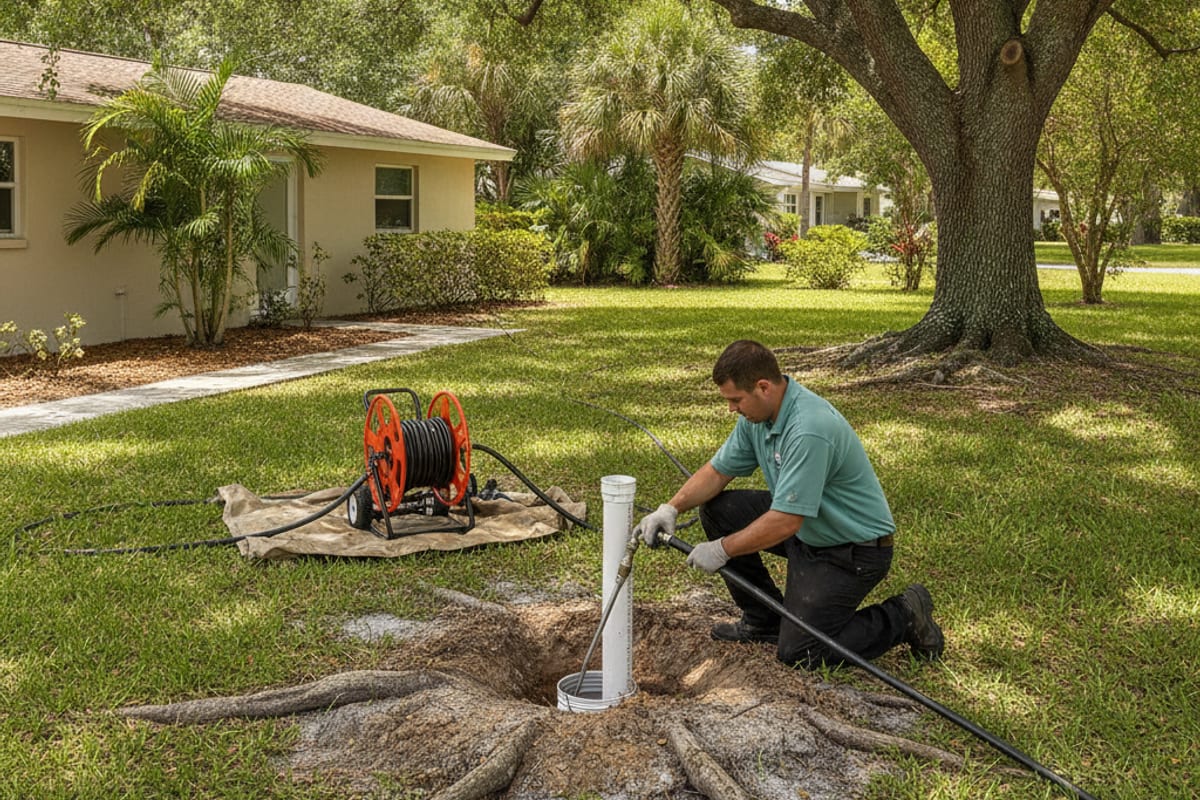
A cable machine, or snake, drives a rotating cable with a cutting head through the blockage. It punches a hole through the obstruction and cuts roots at the joint. It’s fast, cheap, and appropriate for an emergency backup. What it doesn’t do is clean the pipe wall. It bores a channel through the grease and scale, which is why a snaked line often backs up again within months.
Hydro-jetting uses high pressure water through a nozzle that scours the full circumference back to bare pipe wall. It’s the real cleaning, and it’s what actually extends the interval.
The catch is that hydro-jetting a badly corroded cast iron line can open holes in a pipe that was only still holding because the scale was doing structural work. Any competent crew cameras the line first and makes that call based on wall condition. If someone offers to jet a fifty-year-old cast iron lateral without looking at it first, that’s a reason to get another opinion.
Sequence that works: camera first, then clean by the method the camera justifies, then camera again to verify and to see what the pipe looks like underneath the buildup.
Signs you need it now, regardless of schedule
Don’t wait for the calendar if you see any of these:
- More than one fixture draining slowly at the same time
- Gurgling from a tub or shower when a toilet flushes
- Water backing up into a shower pan when the washing machine drains
- Sewage odor from a floor drain in a garage or laundry room
- Toilets that need plunging more than once a month
- Anything backing up out of an outdoor cleanout
Multiple fixtures is the key signal. One slow drain is local. Two or more at once means the problem is in the main line, and that’s your warning before a full backup.
Our post on signs you need sewer line repair in Tampa goes through these in more depth.
What it costs, roughly
Tampa Bay pricing moves with access, line length, and severity, so treat these as ranges rather than quotes.
A camera inspection on its own generally runs a couple hundred dollars, and many companies credit it toward the work if you proceed. A straightforward cable cleaning through an accessible cleanout is typically in the low hundreds. Hydro-jetting runs meaningfully more, often several times the cost of a snake, because it’s a different machine and a longer job.
Costs climb when there’s no accessible cleanout and one has to be installed, when the blockage is far out toward the street, or when the job runs after hours.
The comparison worth making is against a backup. A sewage backup into a finished living space brings water damage restoration and often flooring replacement, and as covered in our piece on plumbing insurance coverage in Florida, sewer backup is typically excluded unless you specifically bought that endorsement. Scheduled cleaning is cheap by comparison.
Who owns which part of the line
This trips people up constantly.
The lateral running from your house to the connection at the main is generally the homeowner’s responsibility, including the portion under your front yard and often under the sidewalk or street. The municipal main itself belongs to the utility.
So a backup caused by a root-filled joint twenty feet from your foundation is your bill, even though the pipe is under a public sidewalk. Exact boundaries vary between Tampa, St. Petersburg, and the county utilities, so it’s worth confirming with yours before you need to know.
If the main itself is surcharged, which happens during heavy rain events when infiltration overwhelms the system, that’s the utility’s problem. Report it rather than paying for a cleaning that won’t help.
The honest answer for most Tampa Bay homes
If your house is pre-1975 and hasn’t been repiped, plan on roughly annual cleaning and get a camera in the line once to find out whether you’re maintaining a serviceable pipe or postponing a replacement. That distinction is worth far more than the cleaning itself.
If your house is newer PVC with no history of backups, don’t buy a schedule you don’t need. Watch for the multi-fixture symptoms and act when they show up.
And if you’re being told to clean the same line every six months, stop and ask what the camera shows. A line that needs constant cleaning usually has a belly, a root-infested joint, or a section that’s structurally done, and continuing to clean it is renting a solution instead of buying one. Our write-up on cast iron pipe failure in older Tampa Bay homes covers what comes next.
We connect Tampa Bay homeowners with experienced local crews for camera inspections, cleaning, and sewer line repair. Reach us at (813) 590-0625, or ask about drain cleaning if the problem is limited to one fixture.
Before scheduling work, verify the company’s CFC plumbing license at myfloridalicense.com. It’s public record.