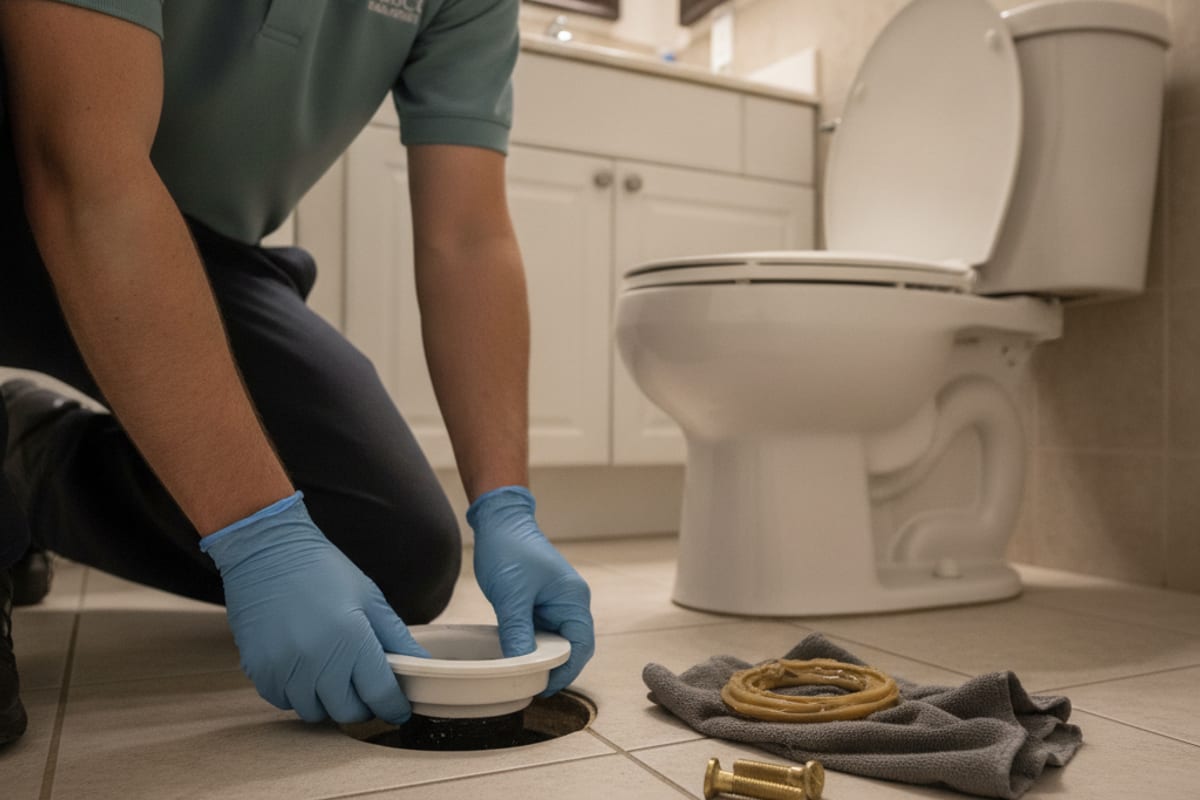
Most homeowners have never heard the word “flange” until a plumber says it standing next to their toilet. It’s a small part, a ring that bolts the toilet base to the drain pipe in the floor, but when it fails, the toilet on top of it fails with it. In Tampa Bay, where a big share of the housing stock still runs cast iron drain lines from the 1960s through the 1980s, flange problems show up more often than most other metro areas, and they get missed because homeowners assume the wax ring underneath is always the culprit.
What a toilet flange actually does
The flange sits flush with (or just above) the finished floor, anchored to the drain pipe below. The toilet bolts down into slots on the flange, and a wax ring between the toilet base and the flange seals the connection so nothing leaks out when you flush. If the flange is solid, that seal holds for years. If the flange is cracked, corroded, or sitting at the wrong height, no wax ring in the world fixes the underlying problem. It just buys a little time before the same symptoms come back.
Why Tampa Bay homes see this more than most
Three local realities stack up here. First, a large percentage of homes built before the mid-1980s in Tampa, St. Petersburg, and Clearwater still have the original cast iron drain stubs, and cast iron flanges rust from the inside out. By the time the metal is visibly flaking at the surface, it’s often already thinned out or cracked underneath the bolt slots, so the bolts have nothing solid left to grip.
Second, most of the region sits on a slab foundation, and the flange in a slab home is set into the concrete itself rather than sitting on a wood subfloor you can easily access from below. That makes a failing flange harder to catch early and more disruptive to fix, since repair usually means working through the finished floor rather than popping a panel in a crawlspace.
Third, Tampa’s hard water, especially in the 11 to 17 grains-per-gallon range common across the metro, doesn’t directly corrode the flange, but it does accelerate wear on the wax ring and the bolts holding the toilet down, which means loose, rocking toilets show up more often here and get blamed on the wrong part.
Signs your flange, not just your wax ring, is the problem
The toilet rocks or shifts when you sit down. A little wiggle after a wax ring swap is one thing. A toilet that keeps rocking even with new bolts and shims usually means the flange itself is cracked or the bolt slots have broken away, so there’s nothing solid to anchor to anymore.
Water pooling around the base after every flush, even after a new wax ring. If a fresh wax ring didn’t fix a leak at the base, the flange is either sitting too low, too high, or is physically damaged. Wax alone can’t bridge a gap that size.
A sewer smell in the bathroom that comes and goes. A properly sealed flange keeps sewer gas contained. An intermittent smell, especially one that gets worse after the toilet’s been rocked or bumped, points to a seal that’s no longer making solid contact.
Soft or discolored flooring around the toilet base. This is the sign that should move fastest. A flange leak doesn’t always show up as standing water. It can wick slowly into subflooring for weeks, and by the time the floor feels soft underfoot, there’s usually real water damage underneath that goes beyond the flange itself.
Visible rust flaking or a crumbling ring when the toilet is pulled. If a plumber lifts the toilet and the flange looks orange, pitted, or breaks away in pieces, that’s a cast iron flange that has corroded past the point of a simple repair.
What actually gets it fixed
For a flange that’s simply sitting at the wrong height, a repair often means adding a flange extender ring or spacer to build it back up to the correct level, which is a same-day fix in most cases. For a cracked or corroded cast iron flange, the repair usually involves cutting out the damaged section and installing a modern PVC repair flange that bolts or solvent-welds into what’s left of the original pipe. That’s more involved, especially on a slab, since it means cutting into tile or flooring to reach it.
If the subfloor has soaked up water from a slow leak, the job grows again. Rotted wood subflooring around the flange has to come out and get replaced before a new flange and toilet go back in, or the same rocking and leaking problem shows up again in a year on top of new materials.
Straightforward toilet repair work, including flange extenders and standard reseating, typically runs $125 to $250. A full flange replacement with a new toilet installation runs closer to $300 to $550, more if subfloor repair is involved. The range depends heavily on whether the flange is accessible under a wood subfloor or set into a slab, and whether corrosion has spread past the flange itself into the drain stub below it.
When it’s more than the toilet
A flange that’s been leaking for a while doesn’t always stay contained to the bathroom floor. On a slab, water finding its way past a bad seal can travel further than expected before it shows up anywhere visible, which is the same reason leak detection sometimes gets called in on what starts out looking like a simple toilet problem. If the floor around the toilet is soft, if there’s a lingering odor with no clear source, or if a water bill has crept up with no obvious explanation, it’s worth having someone check for a bigger leak before just resetting the toilet and hoping it holds. If the fixture on top is old enough that you’re weighing a full replacement anyway, it’s worth checking the toilet rebate your Tampa Bay utility offers before you buy, because the amount depends on the manufacture date stamped inside the tank.
Before you call anyone
If you’re getting quotes on a flange repair, it’s worth confirming the plumber is properly licensed in Florida. You can look up any contractor’s license at myfloridalicense.com before work starts, especially for a repair that involves cutting into flooring or working around a slab.
How do I know if it’s the wax ring or the flange?
If you’ve already replaced the wax ring once and the toilet still rocks, still leaks at the base, or the smell comes back, the flange is almost always the real issue. A wax ring can only compensate for a flange that’s slightly off. It can’t fix one that’s cracked, corroded, or sitting at the wrong height.
Can I fix a toilet flange myself?
A flange extender kit is within reach for a confident DIYer on an easy, accessible install. But if the original flange is cast iron and corroded, or if the toilet sits on a slab, a repair usually means cutting into the pipe or the floor, and a mistake there risks a leak into the subfloor or slab that’s far more expensive to fix than the flange itself.
How long does a toilet flange repair take?
A flange extender or spacer fix is usually done in an hour or two, same day. A full flange replacement, especially one requiring floor or tile work, more commonly takes a half day to a full day depending on what’s found once the old flange comes out.
Is a rocking toilet actually a big deal?
Yes, more than most people assume. Every time a loose toilet rocks, it stresses the wax ring seal a little more, which speeds up a leak that may already be forming. Ignoring it usually turns a straightforward flange repair into a subfloor replacement.
If your toilet has been rocking, leaking at the base after a wax ring swap, or the bathroom’s had a smell you can’t place, call Tampa Plumbing Pro at (813) 590-0625. We’ll check whether it’s the wax ring, the flange, or something further down the line before anything gets pulled apart.