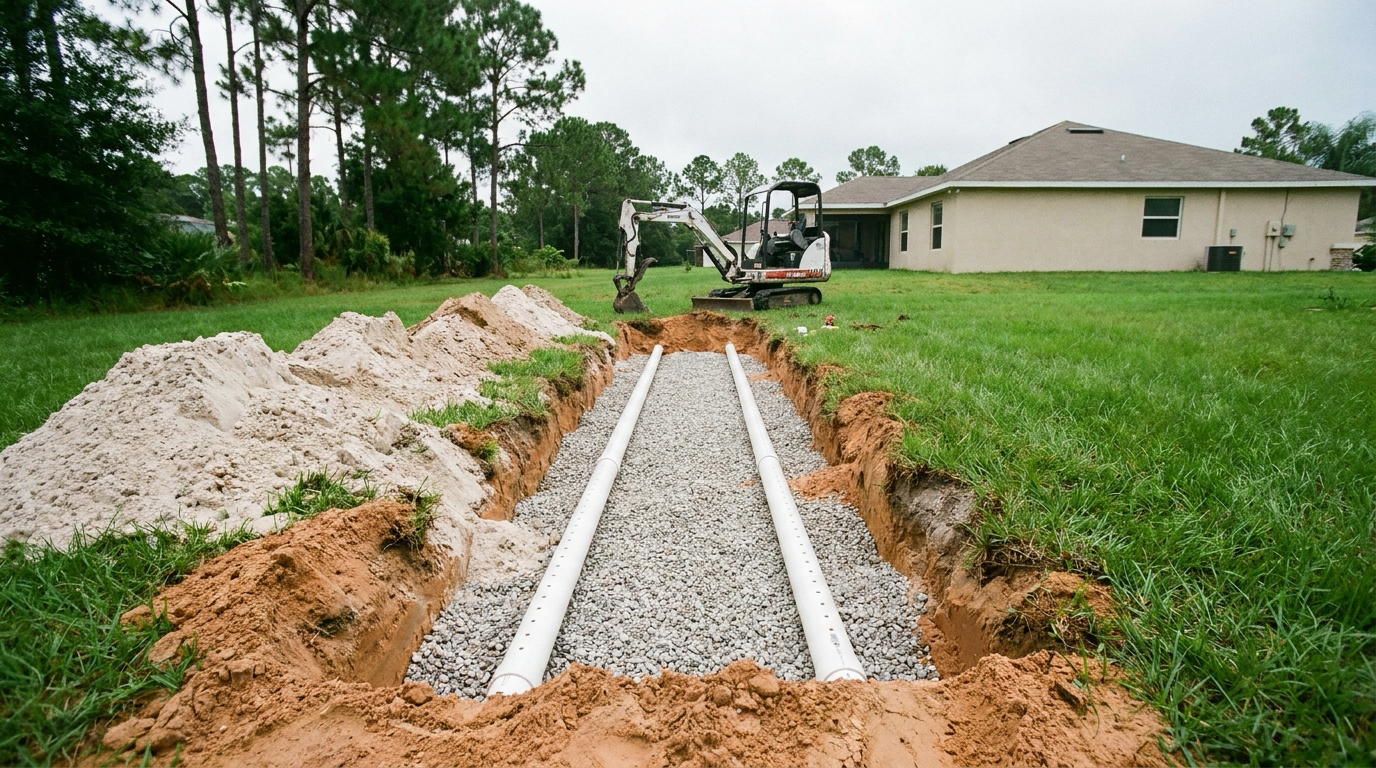
Drain field replacement cost in Tampa Bay starts with $250 in state fees: a $115 site evaluation, a $55 repair permit, a $5 surcharge, and a $75 inspection. The install itself isn’t priced off how bad the failure looks. Florida rule 62-6.015 tells the county how big the replacement field has to be, and that size is what sets the number.
That’s the part most cost guides skip. Homeowners across Land O’ Lakes and Thonotosassa expect to patch the field they have. The rule frequently requires a bigger one.
How much does drain field replacement cost in Tampa Bay?
The fixed, published part of the cost is the state fee schedule in rule 62-6.030. Those amounts are set in rule, and the county health department collects them.
| Item | Fee |
|---|---|
| Site evaluation | $115 |
| Repair permit or permit amendment | $55 |
| Research and training surcharge | $5 |
| Initial system inspection | $75 |
| System reinspection, if needed | $50 |
| Site re-evaluation, if needed | $50 |
| Variance application, single-family home | $200 |
The construction number sits on top of that, and it’s honest to say it can’t be quoted over the phone. The square footage the code requires, the soil on your lot, and how much clear ground you actually have are what move it. A septic contractor sizes those from the site evaluation, not from a description of the smell in your yard.
Tampa Plumbing Pro is available 24/7 across Hillsborough and Pasco County, and you get a firm number after a registered contractor sees the property.
Why does Florida code decide the price, not the damage?
Because a replacement field has to meet current sizing rules, and current rules are usually stricter than whatever was buried in your yard in 1978.
Two provisions do most of the damage to a budget:
Systems permitted on or after January 1, 1983. If the failure came from excessive hydraulic loading, the original field stays in service and a new section gets added. Rule 62-6.015(6)(b) says the resulting drain field “shall be 50 percent larger than the drainfield originally permitted,” or shall meet current sizing criteria, whichever is larger.
Systems installed before 1983. Under 62-6.015(6)(c), if there’s room, the old field can stay and “a new drainfield equal in size to, and separate from, the existing drainfield shall be added,” with flow directed to both. That’s a second field, not a patch.
Either way, the rule sets a floor: the amount of drain field installed during a repair can’t be less than what the system had before, unless there’s genuinely no room left on the lot. Where no additional area exists, 62-6.015(7) lets the permit allow the largest field the available space can hold, still above the wet season water table.
What size does the code require?
Sizing runs off bedroom count and soil texture. These are the residential figures in Tables VI and VII. They apply to pre-1983 residential systems whose existing field can’t be reused as part of the repair. A system permitted in 1983 or later gets sized under the criteria in rules 62-6.008 and 62-6.009 instead.
| Bedrooms | Slightly limited soil (trench / bed) | Moderately limited soil (trench / bed) |
|---|---|---|
| 1 | 75 / 100 sq ft | 100 / 125 sq ft |
| 2 | 150 / 200 sq ft | 200 / 250 sq ft |
| 3 | 225 / 300 sq ft | 300 / 375 sq ft |
| 4 | 300 / 400 sq ft | 400 / 500 sq ft |
| Each added bedroom | 75 / 100 sq ft | 100 / 125 sq ft |
Mound trench systems get sized 10 percent larger, and 20 percent larger if absorption beds go in the mound. A four-bedroom home on moderately limited soil needing an absorption bed is looking at 500 square feet of new field. On a tight lot, finding that space is the whole problem.
When can a drain field be repaired instead of replaced?
Sometimes, and it’s worth asking before anyone starts digging.
Rule 62-6.015(6)(e) covers the cheapest outcome. Where the failure came from roots clogging the distribution box or a drain field line, and clearing the root mass plus replacing the damaged material restores the system’s original design function, the health unit inspects it and “permit satisfaction will be considered to be achieved.” No new field.
Your tank may also survive. Under 62-6.015(6)(f), it doesn’t need replacing if the health unit finds it structurally sound, built of approved materials, and within two tank sizes of the required capacity. It does have to be pumped, and a solids deflection device goes on the outlet if there isn’t one.
Undamaged infiltration units, pipes, and mechanical components can be reused on the same site. The old aggregate and soil cannot: spoil material from a drain field repair is barred from being reused in the repair in any manner.
The rule that ends the conversation
There’s one bright line that matters more than any of the above in this metro. Under 62-6.015(4), where the drain field’s absorption surface sits within 6 inches of the wet season high water table, alternative repair methods are off the table entirely. The rule says the existing field “shall be removed and a replacement drainfield shall be installed.”
That’s a Tampa Bay problem more than a Florida problem. Our water table comes up in the wet season, which is why a system that ran fine in March backs up in August. If your field is sitting that close to it, jetting and injection methods aren’t a legal option, no matter who offers them.
What does the permit process actually involve?
A permit comes first, always. Rule 62-6.015 opens by requiring that all repairs to a failing system “be made only with prior knowledge and written approval from the Department having jurisdiction over the system.”
Since July 1, 2021, the Florida Department of Environmental Protection has run the onsite sewage program under the Clean Waterways Act of 2020. DEP’s own guidance is that “the county health department offices will continue to do the permitting and inspection for septic tanks.” In practice you’re dealing with the Florida Department of Health in Hillsborough County or Pasco County. Hillsborough runs a distinct Repair Permit application package, separate from new construction and modification.
The timeline is better than people expect. The department “shall make every effort to issue a permit within 2 working days” after getting a repair application. The permit is then valid for 90 days, extendable once for another 90 if the system is kept from creating a sanitary nuisance.
The application isn’t a formality. The site plan has to show property dimensions, existing and proposed system layout, water lines, slope, property lines and easements, any private or public wells, and any surface water or stormwater systems nearby. It also has to show obstructed areas, which the rule spells out as patios, decks, swimming pools, and parking areas. A pool deck poured over the only open ground on the lot is a real constraint, and it shows up at permit time.
What setbacks have to be met on a Tampa Bay lot?
Setbacks are where lots run out of room. For systems permitted from January 1, 1983 onward, these are the required separations on a repair.
| Separation | Required | Absolute minimum on a repair |
|---|---|---|
| System to a private potable well | 75 feet | 75 feet, no reduction |
| Drainfield absorption surface to wet season water table | 24 inches | 12 inches |
| Effective soil depth | 42 inches | 36 inches |
| System to surface water | 75 feet | 50 feet |
| System to a non-potable well | 50 feet | 50 feet |
| Drainfield sidewall to start of slope | 4 feet | 4 feet |
| System to property line or building foundation | 5 feet | 2 feet |
The well setback is the one with no give: 75 feet, full stop, for systems of that era. In the well-and-septic belt across rural Pasco, San Antonio, and Thonotosassa, plenty of properties have a well and a failing field on the same acre. Older systems permitted before 1983 fall under different rows with lower absolute minimums, which is one more reason the permit date of your original system matters to the price.
What this usually means for a Tampa Bay homeowner
Three things are worth doing in order.
Get the system evaluated before the failure forces the timeline. A pre-sale septic inspection covering tank condition, baffles, and drain field function runs $150 to $300, and it tells you which side of these rules you’re on.
Stay on a pumping schedule. Solids that should have been pumped out are the most common way a field dies, and a routine pump-out at $350 to $550 every three to five years is the cheap version of this whole conversation. The septic pros we send handle pumping, inspection, and diagnosis, and our septic service page lays out what that covers.
Know what your house is on. If you’re not sure whether you’re on septic or city sewer, our comparison of septic versus sewer in the Tampa suburbs sorts it out. Backups that turn out to be a house-side problem rather than a field problem are usually a drain cleaning or sewer line repair job, which is a very different bill.
Frequently asked questions
How much does drain field replacement cost in Tampa Bay?
State fees come to $250: a $115 site evaluation, a $55 repair permit, a $5 surcharge, and a $75 initial inspection. The install on top of that is set by the square footage Florida’s sizing rules require for your bedroom count and soil texture, which is why it’s quoted after a site evaluation instead of over the phone.
Do I need a permit to replace a drain field in Florida?
Yes. Rule 62-6.015 requires that all repairs to a failing septic system be made only with prior written approval from the department with jurisdiction. The county health department issues it, and the department aims to turn a repair permit around within 2 working days.
Can a failing drain field be repaired instead of replaced?
Sometimes. If the cause is roots clogging the distribution box or a drain field line, and clearing them plus replacing damaged material restores original function, the health unit can accept that as satisfying the permit. But if the absorption surface is within 6 inches of the wet season high water table, the rule bars alternative repair methods and requires removal and replacement.
Why is the new drain field bigger than the old one?
Because current code sizes it, not the old permit. For systems permitted in 1983 or later that failed from hydraulic overloading, the resulting field must be 50 percent larger than what was originally permitted, or meet current sizing criteria, whichever is larger. Pre-1983 systems generally need a second field equal in size to the existing one.
How far does a drain field have to be from a well?
75 feet for systems permitted from January 1, 1983 onward, and that distance can’t be reduced on a repair. Surface water requires 75 feet, reducible to 50 feet on a repair, and a non-potable well requires 50 feet.
Does my septic tank have to be replaced too?
Not necessarily. The tank can stay if the health unit finds it structurally sound, made of approved materials, and within two tank sizes of the required capacity. It has to be pumped as part of the work, and a solids deflection device gets installed on the outlet if one isn’t already there.
Why do drain fields fail in the summer here?
The wet season raises the water table, and a field that had enough separation in the dry months loses it. Sandy soil across Pasco and rural Hillsborough drains fast in spring, then saturates after heavy summer rain, so a system that seemed fine in March backs up in August.
Get the drain field looked at before it decides for you
Call Tampa Plumbing Pro at (813) 590-0625 and we’ll get a registered septic contractor out to inspect the tank and read the field, then tell you plainly whether you’re looking at a pump-out, a repair, or a permit application. We match homeowners across the well-and-septic belt in Land O’ Lakes, Thonotosassa, Dover, San Antonio, and the rest of rural Hillsborough and Pasco County, and the septic contractors we send are licensed and registered for the permitted work.