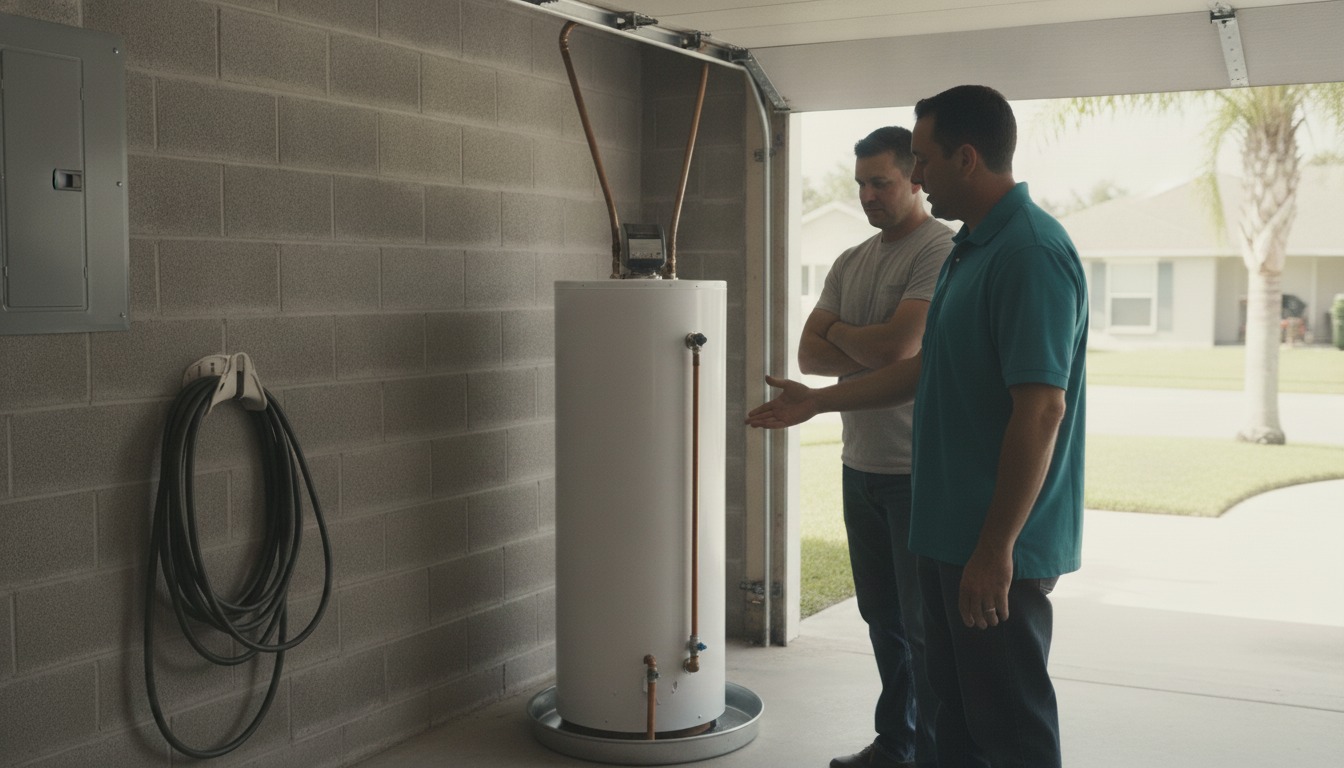
Yes. Replacing a water heater in Tampa requires a building permit, even after this year’s headline change to Florida law. Effective July 1, 2026, the state requires local governments to waive permits on certain single-family work valued under $7,500, but plumbing is written directly into that rule’s exclusion list, so a $1,900 water heater swap doesn’t qualify no matter how far under the threshold it falls. In the City of Tampa, the permit itself runs $120 under the general residential plumbing fee, a small line item next to the $1,400 to $2,600 an installed tank actually costs. Skipping it risks a stop-work order and, in Temple Terrace, a fine that runs seven times what the permit would have cost.
Does Florida require a permit to replace a water heater?
Yes. Hillsborough County publishes a short, specific list of plumbing work exempt from a permit: stopping leaks in a drain, water, soil, waste or vent pipe; clearing stoppages or repairing leaks in pipes, valves or fixtures; removing and reinstalling a water closet; and cleaning septic tanks. Every item on that list stays exempt only if the work doesn’t involve replacing or rearranging valves, pipes or fixtures. A water heater change-out isn’t on that list. Removing an old tank and installing a new one is a plumbing installation, not a repair, and the county treats it as permitted work every time, regardless of the unit’s price or size.
Doesn’t Florida’s new $7,500 rule cover it?
No, and this is the mix-up that trips up a lot of homeowners after this year’s law change. Effective July 1, 2026, Florida Statute 553.79 was amended by Chapter 2026-63 (CS/CS/HB 803) to state that “a local government that issues building permits shall exempt an owner of a single-family dwelling or the owner’s contractor from the requirement to obtain a building permit to perform any work valued at less than $7,500 on the owner’s property.” Read on its own, that sounds like it would cover a water heater swap well under the threshold. It doesn’t, because the same paragraph carves out two categories, and plumbing is one of them. The exemption “does not apply” to work on a property in a flood hazard area, or to “any electrical, plumbing, structural, mechanical, or gas work performed on property containing a single-family dwelling.” A water heater is plumbing work on a single-family dwelling, so it falls inside the carve-out, not the exemption. The City of St. Petersburg’s own building-permits page states the same two exclusions for its version of the exemption form: no flood hazard properties, no structural, mechanical, electrical, plumbing, or gas work.
What does a water heater permit cost around Tampa Bay?
It depends on the city, and none of the jurisdictions treat a water heater as its own fee line. In the City of Tampa, a change-out falls under the general residential plumbing permit, $120 flat, per the city’s Trade Permit Fee Schedule, plus the state’s building permit surcharge of 2.5% of permit value or a $4 minimum. Gas water heaters draw a separate fee: Tampa lists natural and LP gas piping as its own $162 residential line, so gas piping work isn’t covered by the $120 plumbing fee alone. In Temple Terrace, the math works differently. The city charges $12 per wet fixture, and its schedule counts a water heater as one, but that lands under the city’s $50 minimum permit fee, plus an $8.50 processing fee. Unincorporated Hillsborough County and Pinellas County don’t publish a flat water heater figure, so check your city or county’s current fee schedule or ask the plumber handling the job. Either way, a standard 40 to 50-gallon tank replacement runs $1,400 to $2,600 installed in Tampa Bay, and the permit is a small fraction of that.
What happens if you skip the permit?
A fine that costs more than the permit would have. Temple Terrace’s fee schedule states plainly: “A minimum fee of $350 will be assessed for each discipline issued a stop work order for working without permit.” That’s seven times the $50 permit that would have covered the job. Hillsborough County’s homeowner permitting page sets a similar consequence: if work starts before a permit is pulled, the homeowner must stop immediately and contact [email protected] for an After-The-Fact permit, or face citations up to $500 per violation. A water heater that fails and floods a garage while none of this is sorted out can turn into an emergency plumbing call on top of the fine.
What is the inspector actually checking?
A handful of specific things, all from the Florida Plumbing Code. Section 504.7 requires a pan wherever a leak from the tank “will cause damage,” built from galvanized steel or aluminum at least 0.0236 inch thick, or plastic at least 0.036 inch thick (a plastic pan isn’t allowed under a gas water heater). The pan has to be at least 1½ inches deep with a ¾-inch drain, and that drain has to either run to a floor drain or waste receptor, or extend outside the building and stop somewhere between 6 and 24 inches above the ground, a detail you can actually walk outside and check for yourself. The relief valve’s discharge pipe has its own rules under Section 504.6: no tie-in to the drainage system, an air gap in the same room as the heater, no trap, and gravity flow the whole way. If your home has a pressure-reducing valve, which Florida code requires whenever static pressure runs above 80 psi (covered in full in our guide to high water pressure in a Tampa Bay house), the water heater also needs a thermal expansion device on its cold supply line downstream of that valve, per Section 607.3, since the valve turns the system into a closed loop with nowhere for expanding hot water to go. The licensed plumbers in our network build this into the install rather than treating it as separate inspection prep.
Does Florida require seismic strapping on water heaters?
No. Seismic strapping is a West Coast earthquake-code requirement, and it shows up constantly in national water heater articles that don’t account for regional code differences. Florida’s Plumbing Code doesn’t require it, and it isn’t part of what an inspector checks on a Tampa Bay installation. What a Florida inspector does check is the pan, the relief valve discharge piping, and the thermal expansion control covered above, not strapping.
Can I pull the water heater permit myself?
Yes, if the property is your primary residence and you handle the work as an owner-builder under Florida Statute 489.103(7). Hillsborough County requires the home to be in your name, a recorded copy of the deed if you bought it recently, and a signed Owner Builder Disclosure Statement before it issues the permit. The statute requires direct, onsite supervision by you, and a written acknowledgment that you’re “the party legally and financially responsible for this proposed construction activity.” One trade-off is worth knowing before you go that route: selling the property within a year of finishing owner-builder work “creates a presumption that the construction was undertaken for purposes of sale or lease,” which is the situation the exemption isn’t meant to cover. If you’d rather hand the whole thing off, how to choose a licensed plumber in Tampa Bay covers what to ask before you hire. This year’s law change also opened a faster private-provider path under Florida Statute 553.791, which now names “water heater changeouts” and “repiping” as single-trade work eligible for private plan review instead of the standard county counter, a route homeowners use through a hired private provider rather than pulling the permit themselves. The licensed plumbers we send for a repipe run into that same option on bigger jobs.
What if there’s an old open permit on the house I bought?
You’re not automatically on the hook for it. Florida Statute 553.79 gives a property owner the option, not the obligation, to close an old permit left by a previous owner, either through the original contractor, a different licensed contractor, or the owner-builder route. More importantly, if you bought the property in an arms-length sale, the same statute says the local building department “may not deny issuance of a building permit to; issue a notice of violation to; or fine, penalize, sanction, or assess fees against” you solely because a prior owner never closed one out. The county keeps its enforcement rights against that previous owner and their contractor, not you. Our 4-point inspection guide covers the plumbing side of what else to check before closing on an older Tampa Bay home.
Frequently asked questions
Do I need a permit for a water heater repair, or just a full replacement?
Repairs that don’t involve replacing pipes, valves, or fixtures, like clearing a stoppage or fixing a leaking valve without swapping parts, are exempt in Hillsborough County. Installing a new water heater isn’t a repair in that sense, it’s an installation, so it needs a permit every time regardless of price.
What does the water heater permit cost in the City of Tampa?
$120 for the general residential plumbing permit, plus the state’s building permit surcharge of 2.5% of permit value or a $4 minimum. Tampa’s fee schedule doesn’t list a water-heater-specific line, so a change-out falls under that general plumbing fee.
Is a gas water heater permit different from an electric one?
It can be. Tampa’s fee schedule lists natural and LP gas piping as its own $162 residential line, separate from the $120 general plumbing fee, so a gas change-out involving new gas piping can draw an additional fee line beyond the base plumbing permit.
What’s the water heater permit fee in Temple Terrace?
Temple Terrace charges $12 per wet fixture, and a water heater counts as one, but that lands under the city’s $50 minimum permit fee. So $50, plus an $8.50 permit processing fee, is what applies to a single water heater change-out there.
Does Florida require seismic strapping on water heaters?
No. That’s a West Coast earthquake-code rule that shows up in national articles but isn’t part of the Florida Plumbing Code, and it isn’t something a Tampa Bay inspector checks during a water heater installation.
How long does a water heater permit stay valid?
One year from issuance, or until the next edition of the Florida Building Code takes effect, whichever is later. A local government can extend a permit beyond that date if the job needs more time.
Can I pull the water heater permit myself as the homeowner?
Yes, as an owner-builder under Florida Statute 489.103(7), if the home is your primary residence and you provide direct, onsite supervision yourself. Hillsborough County also requires a signed Owner Builder Disclosure Statement, and selling the property within a year raises a legal presumption the work was done to flip it.
What if the house I bought has an old open permit from a previous owner?
You’re protected. Florida law says a local building department can’t deny you a new permit, cite you, or fine you solely because a prior owner never closed out an old one, as long as you bought the property in an arms-length sale. The county keeps its enforcement options against the previous owner and their contractor instead.
Let the licensed plumbers we connect you with handle the permit
Pulling a water heater permit yourself means gathering the paperwork, submitting the request, and being on-site for every inspection until it closes. The licensed plumbers in our network handle all of that as a normal part of the job, so nothing sits open on your property after the work is done. Call Tampa Plumbing Pro at (813) 590-0625 and the licensed plumbers we send pull the permit as part of the job.