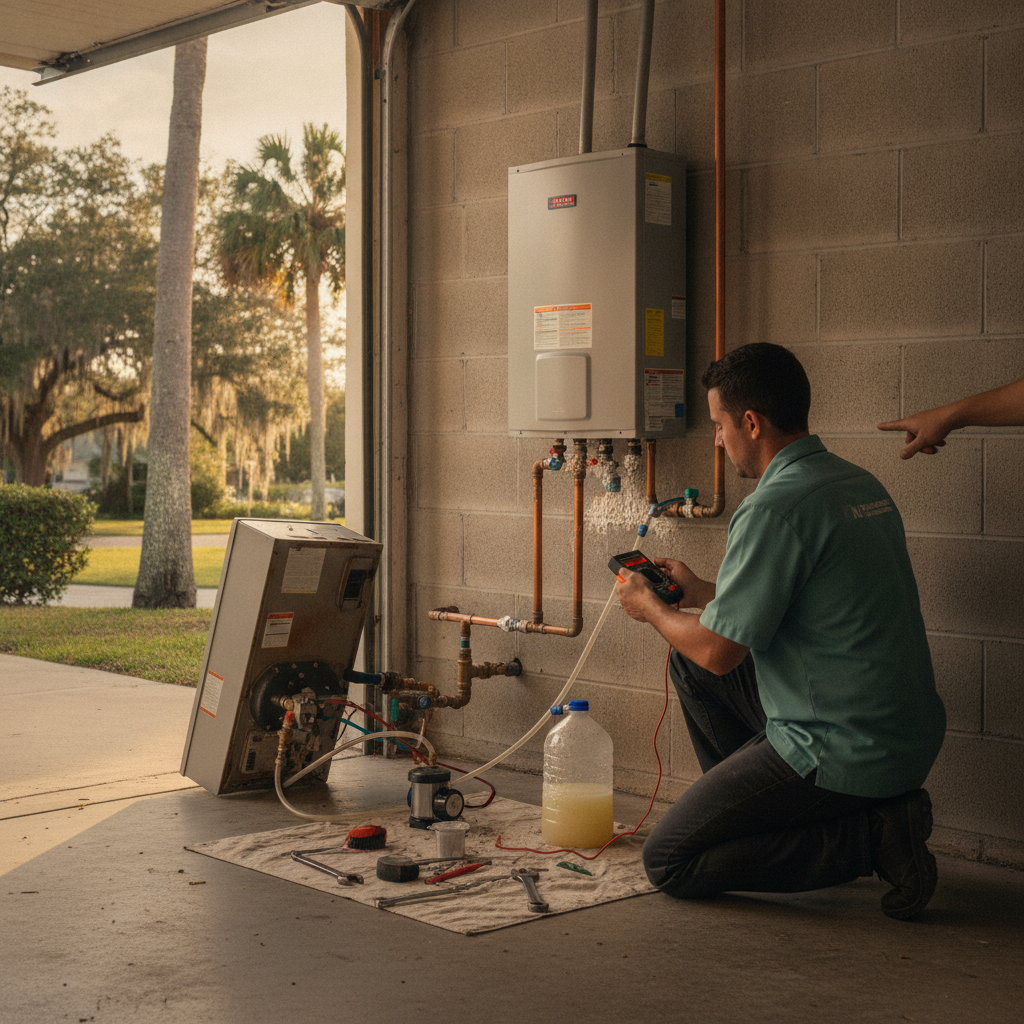
A blinking display in a Carrollwood garage and a lukewarm shower upstairs usually arrive together. The unit is not being mysterious. It watches flow, flame, and overheating, and it shuts down before it cooks the heat exchanger. That is where tankless water heater repair starts in Tampa Bay: read what the board is saying, then look at scale, because City of Tampa finished water averaged 211 mg/L of hardness in 2025, or 12.3 grains per gallon.
Tankless water heater repair starts with the code
A tankless heater only fires when water is moving through it. Open a hot tap, a flow sensor sees that movement, a burner or element comes on, and water leaves hotter than it entered. When any step in that chain fails, many units lock out and print a code instead of sending lukewarm water forever. The code is a clue, not the repair. The same cold shower can be a dirty inlet screen, a failed igniter, a blocked vent on a gas unit, or a heat exchanger so scaled that the board thinks the unit is overheating.
No hot water with a blank or idle display is a different scene. The unit may not be getting gas, 120-volt power, or enough flow to wake up. Galvanized supply in a Seminole Heights or Hyde Park bungalow narrows from the inside as it corrodes. A tankless unit that needed a strong stream to fire ten years ago can sit dark once that pipe has closed down. The heater is not always the broken part. The plumbers we send check supply, shutoffs, and the inlet screen before they order a board.
Fluctuating temperature is the other common call. You get a burst of heat, then a cool slug, then heat again. That can be a flow sensor sticking, an undersized unit trying to serve a shower and a dishwasher at once, or scale interrupting heat transfer so the burner short-cycles. Reduced flow at every hot tap points at the heater or the home’s hot supply. Reduced flow at one tub, with the rest of the house fine, is often a fixture or a drain. If the washing machine or shower sends water back onto the floor while the tankless is running, that is drain cleaning territory, not a heater fault.
Outdoor units on St. Pete Beach and the Gulf islands add salt air to the same electronics and burners. Indoor units in a Brandon or Valrico garage pick up dust and lawn debris on the intake screen instead. Either way, the licensed plumber reads the code against the model, then proves the fault with flow, flame, and temperature, rather than swapping the first part that looks familiar.
Hard water scale on Tampa Bay tankless units
Scale is the local failure, not a generic “mineral buildup” line. A tankless heat exchanger is a narrow metal maze. Hard water leaves calcium and magnesium on those walls. The coating acts like insulation, so the burner runs longer to hit the set temperature, the exchanger overheats, and the board trips. Inlet filters clog with the same crust. Flow drops, the unit never lights, and the shower stays cold.
City of Tampa’s 2025 water quality report put average finished-water hardness at 211 mg/L. Rinnai’s residential condensing N-Series manual lists total hardness in its water-quality guidelines at a maximum level of 200 mg/L, and it says water that contains chemicals exceeding those listed levels can damage the heater. That is a guideline versus an annual plant average, not a ban. Rinnai does not say a tankless unit cannot be installed here, and it does not say a warranty is automatically void. What the same manual does say is blunt: if you install the heater where water is known to be hard or to cause scale, the water must be treated and may need a more frequent flushing schedule. Scale build-up is caused by hard water and can be accelerated if the heater is set hot. Failure to flush the appliance will cause damage to the heat exchanger. Damage caused by lime build-up is not covered by that water heater’s warranty. Replacement of the heat exchanger due to water quality damage is not covered either. Those terms belong to Rinnai, for those models. Other brands write their own manuals.
Pinellas County Utilities’ 2024 consumer confidence report published total hardness of 210 ppm, with a range of 168 to 252, which the report itself converts to 9.8 to 14.7 grains. That Pinellas copper-and-hardness data is from 2023; the report says it is still representative even though it is more than a year old. Across the metro, this site already describes Tampa Bay water as running 8 to 17 grains per gallon depending on season and source. Pasco does not publish a countywide hardness figure. Well homes in Land O’ Lakes, Odessa, and Thonotosassa still send extra sediment and minerals through a tankless inlet screen, which is why those units often fail on flow before they fail on flame.
A water softener is the treatment Rinnai is pointing at when it says hard water must be treated. The hard-water water heater problem is the same chemistry on a tank: crust on heating surfaces. On a tankless unit the passages are simply smaller, so the same grains show up as error codes and cold water sooner. Flushing a tankless heat exchanger is not the same job as draining a 40-gallon tank. It uses service valves, a pump, and a descaling solution through the exchanger. There is no standalone descaling price on this site. What we do publish is the general water heater repair range: most repairs run $150 to $450 depending on the part. A flush is a service inside that world, quoted after the plumber sees the unit, the valves, and how far the scale has gone.
Repair versus replace on a tankless
A replaceable part is worth repairing. A cooked heat exchanger is not. Igniters, flame rods, flow sensors, inlet screens, and gas valves come off and go back on. The copper or stainless maze that actually heats the water does not get a patch. Once scale has closed those passages, or a freeze, overheat, or corrosion has opened a leak in the exchanger, the unit is done. Repeated scale lockouts after a proper flush are the tell. The board is not haunted. The water cannot get through.
| What you are seeing | What it usually means | Why the job heads that way |
|---|---|---|
| One code, dirty screen, weak igniter | A part or a flush can restore heat | The exchanger is still open |
| The same scale lockout after flushing | Passages in the exchanger are closing | Solution cannot open a blocked tube |
| Water weeping from the exchanger body | The heating core itself has failed | There is no repair for that leak |
| Good heat until two fixtures run | The unit is undersized for the house | A working heater still cannot keep up |
Undersizing is not a repair. Florida incoming water is warmer than a northern city, so a given unit can raise temperature with less burner work, but it still has a flow ceiling. A late-1990s Valrico two-story that added a tankless during a kitchen remodel, then added a soaking tub, will starve the far bathroom every morning. Replacing the board will not add gallons per minute.
Age alone is a weak cutoff. Brochures talk in decades. What actually ends a tankless heater here is skipped flushing, untreated hard water, a vent that was never right, or a heat exchanger that has already been scaled once too often. If you want the tank-side version of that call, read repair versus replace on a storage heater. For how tankless units are supposed to be chosen in the first place, the Florida tankless guide is the sibling page. A full tankless replacement on this site is published at $3,500 to $6,500 installed. That number moves with gas-line or electrical work, venting, location, and whether the old unit left decent service valves behind. Standard 40 to 50-gallon tank replacement sits at $1,400 to $2,600 installed, which is why some homes go back to a tank after a second tankless heat exchanger.
Restricted galvanized or failing polybutylene will sabotage even a new unit. If the flow sensor never sees a clean, strong stream, the heater never lights. That is a whole-home repipe conversation, not another heater. Confirm the plumber’s license on Florida’s DBPR search before anyone opens a gas line.
What is the most common problem with tankless water heaters?
Scale on the heat exchanger, especially on Tampa Bay city water. Hardness at the plant already sits near or above the guideline some manufacturers print, and a high temperature setting speeds the crust. The usual symptoms are error codes, lukewarm water, and a unit that will not fire until someone flushes it.
How much does it cost to repair a tankless water heater?
Most water heater repairs on this site run $150 to $450 depending on the part. That is the published repair range, not a descaling menu price. A new tankless unit is published at $3,500 to $6,500 installed. The honest fork is whether the heat exchanger is still open. A sensor or igniter stays in the repair band. A closed or leaking exchanger leaves the replacement band.
When to call us
Call when the display is locked out, the shower is lukewarm, or you can hear the burner short-cycle every time someone opens a tap. Gas, venting, and heat-exchanger work belong to a licensed plumber, not a vinegar jug and a weekend. We match you with licensed local plumbers who service tank and tankless units across Hillsborough, Pinellas, and Pasco. Call us at (813) 590-0625.