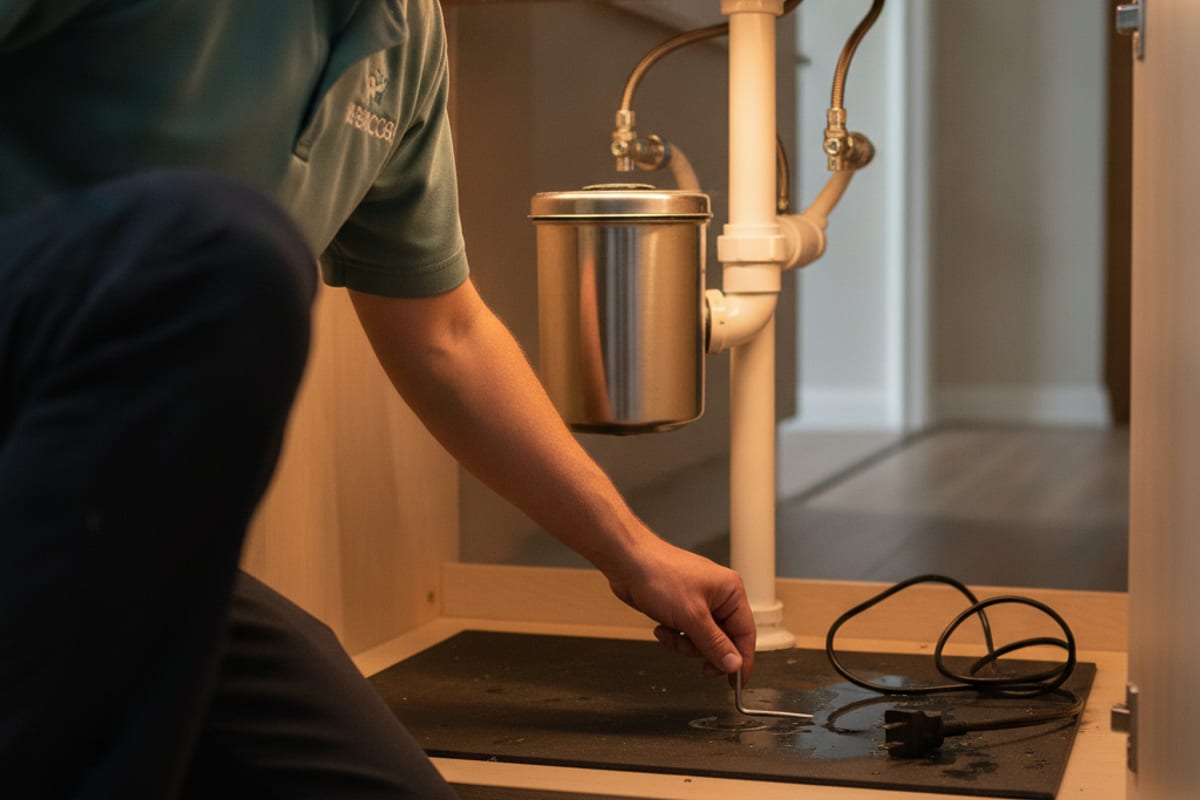
Before anything else: cut the power. Unplug the disposal under the sink, or flip its breaker. Never put a hand or a tool into the chamber with power live, and never trust the wall switch as your safety. The reset button on the unit can send it back to work without warning.
With that done, the sound your disposal makes tells you almost everything.
It hums but won’t turn
A hum means the motor has power and the grinding plate is jammed. This is the most common failure and usually the easiest.
Don’t hold the switch on. Ten or fifteen seconds of a stalled motor is enough to trip it, and holding it longer can burn the windings out for good.
With the power off, look at the bottom center of the unit for a hex-shaped socket. Most disposals ship with a small hex wrench, often clipped to the housing. A quarter-inch Allen key works too.
Insert it and work the plate back and forth, both directions, until it spins freely through a full rotation. You’ll usually feel the obstruction let go.
Then reach into the chamber and pull out whatever caused it. Use tongs or pliers, not fingers. Common finds are a bottle cap, a twist tie, a fruit pit, a fragment of glass, or a piece of silverware that went in with the plate scrapings.
Press the red reset button on the bottom of the unit, restore power, run cold water, and try it.
If there’s no hex socket on your model, you can work a broom handle against the grinding plate from inside the chamber for the same effect. Power off, always.
It’s completely silent
No hum means no power reaching the motor. Work outward in this order:
Reset button. The red button on the underside. If it’s popped out, the thermal overload tripped. Push it in, wait a few minutes for the motor to cool, and try again. Let it cool first, because resetting a hot motor just trips it again.
Breaker. Check the panel. Kitchen circuits in Tampa Bay homes often carry the disposal, dishwasher, and several counter outlets together, so look for anything else in the kitchen that’s also dead.
Plug. Confirm the disposal is actually plugged in and the outlet has power. Test the outlet with something else. Under-sink outlets take abuse from cleaning supplies and occasional leaks.
Switch. If the reset holds, the breaker is on, and the outlet is live, the wall switch or the unit itself has failed. Switches are cheap. Motors that trip repeatedly after cooling are usually done.
A disposal that trips its reset every few days is telling you the motor is failing or the unit is undersized for what it’s being asked to grind. Most last around eight to fifteen years.
It runs fine but the sink drains slowly
The disposal is working. The drain line below it isn’t.
Try the basics first. Fill the basin with several inches of hot water, then run the disposal while pulling the stopper, so volume pushes the debris through. A plunger over the drain works too, though on a double sink you need to seal the other side or you just move water sideways.
Never use chemical drain cleaner on a disposal. It pools in the chamber, attacks the seals, and makes the unit hazardous for whoever opens it next.
If it keeps slowing down, two Tampa Bay specifics are worth knowing.
Hard water. Water across most of Hillsborough and Pinellas runs hard, and the scale that builds on a water heater element builds inside disposal chambers and drain lines too. Combined with grease, it narrows the pipe steadily until a normal load of scraps won’t clear. If you’ve noticed scale on fixtures and shower doors, the same thing is happening where you can’t see it. A water softener addresses the cause rather than the symptom.
Cast iron. In homes built before roughly 1975, the kitchen drain line is likely cast iron, and fifty years of grease and scale leaves a pipe with a fraction of its original diameter. At that point the disposal isn’t the problem and no amount of plunging fixes it. That’s a drain cleaning job with a camera, and the camera is the part that tells you whether you’re clearing a clog or looking at a pipe that needs replacing.
It’s leaking, and where matters
Where the water appears identifies the failure.
From the top rim, where the unit meets the sink. The sink flange seal has failed. The disposal gets dropped, remounted, or simply loosens over years of vibration. Fixable by dismounting the unit, cleaning off the old plumber’s putty, and resetting it with fresh putty. Straightforward but fiddly.
From the side. Look at the two side connections. One is the dishwasher inlet hose, the other is the discharge tube to the drain. Both are clamped or bolted joints with gaskets, and both are cheap fixes. Tighten first, replace the gasket if tightening doesn’t do it.
From the bottom center. This one is terminal. Water coming out of the bottom of the housing means the internal motor seal failed and water is now getting into the motor. There’s no seal kit worth installing. Replace the unit, and do it soon, because water in a motor housing is an electrical hazard.
A quick way to confirm the source: dry everything completely, put a paper towel underneath, and run water. The first wet spot tells you where to look.
If you’re on septic, think twice about the disposal at all
Much of Pasco County and rural Hillsborough runs on septic rather than city sewer. Land O’ Lakes, Odessa, and Shady Hills are largely on tanks and drainfields.
Garbage disposals are hard on septic systems. Ground food waste adds solids the tank has to handle, which builds the sludge layer faster and shortens the interval between pumpings. Heavy disposal use on septic can meaningfully accelerate drainfield trouble, and a drainfield is the expensive part of the system.
If you’re on septic and use a disposal regularly, shorten your pumping interval and keep an eye on it. Composting or trashing food scraps is the cheaper path. Our septic service page covers maintenance intervals in more detail.
What actually causes most failures
Not much belongs in a disposal, and the list of what doesn’t is longer than people expect.
Grease and cooking oil are the worst, because they go down warm and solidify in the line. Fibrous vegetables like celery and corn husks wrap the plate. Starchy foods, pasta, rice, and potato peels swell and turn to paste. Coffee grounds pack into sludge. Eggshells contribute grit rather than helping sharpen anything, which is a persistent myth. Bones, fruit pits, and anything non-food are simply jams waiting to happen.
Habits that extend the life of the unit: run cold water before, during, and for thirty seconds after, since cold keeps fats solid so they get chopped and flushed instead of coating the pipe. Feed scraps in gradually. Run it regularly, because a disposal that sits unused corrodes.
When to call someone
Handle it yourself for a jam, a tripped reset, a loose side connection, or a slow drain that clears.
Call when:
- Water is coming from the bottom of the housing
- The reset trips repeatedly after cooling
- There’s no power and the breaker, outlet, and switch all check out
- The sink drains slowly no matter what you do
- You’re smelling sewer gas along with the drainage problem
- The unit is well past a decade and failing in more than one way
That last combination is usually a replacement rather than a repair, and on an older Tampa Bay home it’s worth having someone look at the drain line at the same time, since the disposal often gets blamed for a pipe problem.
We connect Tampa Bay homeowners with experienced local crews for kitchen drain and disposal work. Reach us at (813) 590-0625, or see faucet and fixture installation for replacement work.
Before hiring anyone, verify their CFC plumbing license at myfloridalicense.com. It’s public record and worth the minute.