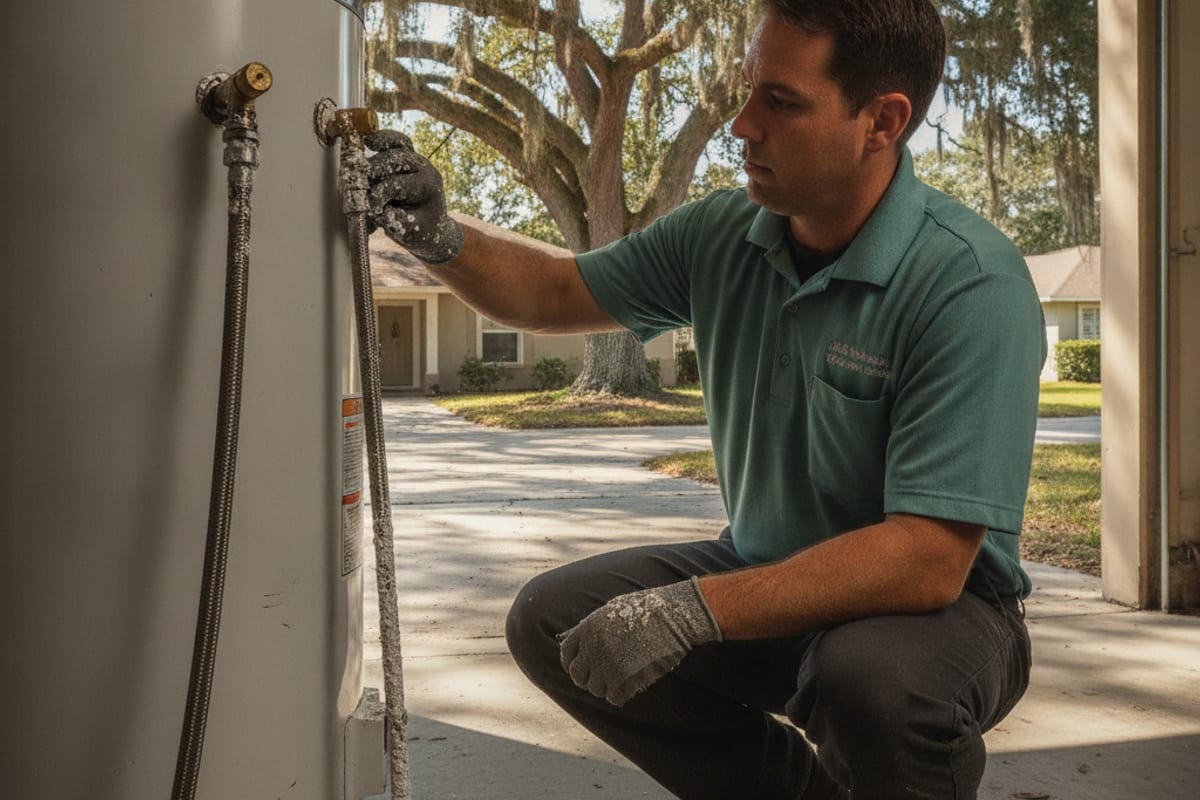
Valrico grew fast in the 1980s and 1990s, and a lot of those homes sit on slab with the original supply lines under the concrete and Hillsborough County water at the meter. Plumbing trouble in a Valrico home usually begins on one of three sides: the pressurized water supply, the drain and sewer system, or a fixture or appliance. Water appearing while every fixture is off points toward a supply or equipment leak. Water rising when another fixture drains points toward the waste side. Neither the home’s age nor its location proves which pipe material is installed. Inspection comes before diagnosis.
Start with the symptom, not the pipe material
The way a problem appears often narrows the search before anything is opened. One slow sink behaves differently from several drains slowing together. Weak flow at one faucet suggests a local restriction, while weak flow throughout the house calls for a broader check.
- A water meter that moves while every fixture and water-using appliance is off may indicate water flowing somewhere on the property.
- Water collecting beneath a sink, beside a toilet, or near a water heater points toward that fixture, its connections, or a nearby supply line.
- A tub filling when a toilet flushes or washing machine drains points toward a shared drain restriction.
- Gurgling from several fixtures can develop when air and wastewater aren’t moving normally through the drain system.
- Discoloration at one tap may begin with that fixture, its connector, or nearby piping, while a house-wide change needs a wider water-source check.
- A rising water bill can come from toilets, faucets, irrigation, a water softener cycle, an underground line, or another source that needs to be isolated.
EPA WaterSense recommends checking the meter while no water is being used and examining fixtures such as toilets, faucets, and showerheads during a household leak search. Its leak-detection guidance offers a useful starting point, but meter movement doesn’t reveal the leak’s location. A plumber can isolate branches and equipment through a professional leak-detection visit.
Supply pipe trouble and drain trouble aren’t the same job
Supply pipes carry pressurized clean water toward fixtures. Drains carry wastewater away by gravity. Repiping the supply system doesn’t replace cast iron drains, and replacing a damaged sewer run doesn’t correct a leaking water line.
| What you notice | Side that needs attention | What the inspection looks for | Possible next step |
|---|---|---|---|
| Water appears when fixtures aren’t running | Supply, fixture, or appliance | Active moisture, meter movement, connectors, valves, and branch lines | Repair an isolated failure or evaluate broader supply repiping |
| One fixture drains slowly | Fixture trap or nearby branch drain | A local obstruction and the condition of accessible fittings | Clear the local line, then inspect further if the symptom returns |
| Several fixtures slow or back up together | Shared building drain or sewer lateral | The blockage location and the pipe’s internal condition | Drain cleaning, a localized repair, or wider drain replacement |
| Flow is weak at one faucet | Fixture or local supply connection | Aerator, cartridge, shutoff valve, and connector condition | Service the affected fixture or connection |
| Flow is weak throughout the house | Main supply, control equipment, or several branches | Pressure behavior, valves, filters, softener, and supply layout | Correct the isolated restriction or assess the supply system |
| Hot water alone is discolored or unreliable | Water heater or hot-water piping | Tank condition, connections, controls, and hot-side piping | Repair the serviceable part or compare replacement requirements |
Cast iron can be present in a drain system without being the source of a current backup. A camera inspection can show corrosion, cracks, roots, standing water, or an obstruction after the line is accessible. Drain cleaning addresses the blockage. Structural damage calls for a separate repair decision.
Water quality changes need a source check
A change at one fixture and a change throughout the house lead to different inspections. Start by comparing hot and cold water at more than one tap. Then identify the actual utility shown on the water bill instead of assuming every Valrico address has the same provider.
Hillsborough County’s water-quality guidance helps separate household plumbing and water-softener issues from concerns that may involve the water provider. If the home has a filter or softener, its condition and operating cycle belong in the inspection. Scale on a fitting may identify mineral residue, but it doesn’t prove that concealed copper, PEX, or another material has failed.
Hot-side symptoms deserve their own check. Water that changes only after the hot tap opens can lead the inspection toward the heater and hot-water piping. A water heater repair evaluation can compare the tank, connections, controls, and visible piping before anyone recommends replacement.
What a useful plumbing inspection includes
A useful inspection follows the symptom through the system. On the supply side, the plumber may examine exposed pipe, shutoff valves, fixture connectors, the water heater, filters, and the softener. Meter observation and branch isolation can narrow an active leak without blaming every pipe in the house.
On the drain side, the plumber traces which fixtures share the problem. Clearing an obstruction may restore flow, but repeat trouble can justify a camera inspection. The camera findings should identify where the defect sits, how much of the run is affected, and whether the surrounding pipe appears serviceable.
Existing repair records also matter. A house may contain original pipe, newer sections, and several materials from past work. Build date alone can’t show what remains behind the walls or beneath the slab.
Choosing between repair and replacement
A focused repair makes sense when the failure is isolated and the surrounding system remains serviceable. A broader replacement becomes easier to justify when testing finds repeated failures, damage across several sections, or a layout that can’t be corrected reliably with another patch.
Supply repiping is a distribution project. It replaces the lines carrying water to sinks, toilets, showers, and appliances. The quote changes with access, the number of branches and fixtures, wall or ceiling work, material selection, and the restoration needed afterward.
Drain or sewer replacement is a wastewater project. The quote depends on the damaged run’s location, depth, length, camera access, slab or yard work, and the surfaces that must be opened and restored. If inspection confirms cast iron, that finding still doesn’t decide between one repaired section and a larger replacement. The location and spread of actual damage do.
Fixtures and water heaters follow the same condition-based approach. A serviceable valve, connector, or control can support a focused repair. A leaking tank, repeated failures, or damage involving several components can shift the decision toward replacement. The inspection should explain that boundary in plain language.
What to do before the plumber arrives
The best immediate step is to stop adding water to the affected part of the system. Close an accessible fixture shutoff for a local supply leak. Use the home’s private main shutoff when water is escaping and the local valve doesn’t stop it. If wastewater is backing up, stop running nearby fixtures and appliances.
Record where the symptom appears and what was running at the time. Note whether it affects hot water, cold water, one fixture, or several. For an unexplained meter change, turn off normal water use and observe the meter without opening utility equipment. These details help the plumber begin with the right system.
Frequently asked questions
Does a Valrico home’s age reveal its pipe condition?
No single age establishes pipe material or condition. Renovations and partial repairs can leave several generations of plumbing in one house. Visible markings, repair records, testing, and camera findings provide better evidence.
How can I tell a supply leak from a drain problem?
A supply leak can release water even when nothing is draining. A drain problem usually appears while water is leaving a fixture or when another fixture uses the same waste line. An inspection confirms the source before repair work begins.
Does one slow drain mean the sewer line needs replacement?
No. One slow fixture can result from a local obstruction. Several affected fixtures, repeat backups, or camera-confirmed structural damage support a broader drain or sewer evaluation.
Does white residue prove the house needs repiping?
No. Residue on an exposed fitting shows what has collected at that location. It doesn’t reveal the condition of every concealed supply line. Leak history, flow behavior, visible corrosion, and testing shape the repipe decision.
Can cast iron be repaired without replacing every drain?
Sometimes. A localized defect may support a section repair, while widespread cracking, corrosion, or deformation may call for a larger replacement. A clear camera recording should show why either path is being recommended.
What determines the quote for plumbing work?
The quote follows the confirmed scope. Access, affected length, pipe location, fixture connections, slab or wall work, material selection, and surface restoration can all change the job. Supply repiping and drain replacement should be quoted as separate systems.
When to call us
Call when water is escaping, several drains are backing up, trouble keeps returning, or you need an inspection before choosing repair or replacement. Tampa Plumbing Pro connects Valrico homeowners with independent licensed plumbers who perform the work. Call us at (813) 590-0625.